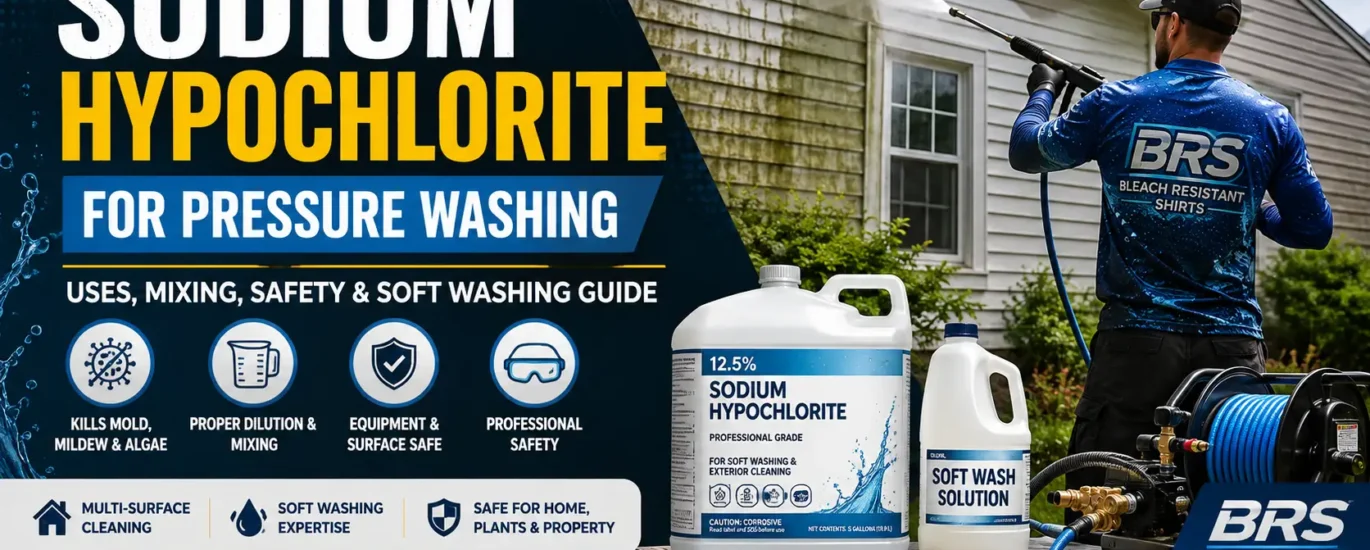
Sodium hypochlorite is widely used in professional exterior cleaning because it can chemically treat algae, mold, mildew, and other organic growth that water pressure alone may not effectively address. It is particularly important in soft washing, where cleaning chemistry does more of the work and mechanical pressure is intentionally kept lower.
However, using sodium hypochlorite for pressure washing is not as simple as buying a container marked 12.5% and spraying it on a surface. Stock strength, dilution, application equipment, substrate, weather, dwell time, surrounding vegetation, and manufacturer instructions all affect how a sodium hypochlorite solution should be used.
Safety note: Sodium hypochlorite is a reactive chemical. Always follow the chemical manufacturer’s label and Safety Data Sheet (SDS), the cleaning-surface manufacturer’s recommendations, and your equipment manufacturer’s instructions. Never mix sodium hypochlorite with acids, ammonia-containing products, or other incompatible chemicals.
What Is Sodium Hypochlorite Used for in Pressure Washing?
Sodium hypochlorite, commonly associated with chlorine bleach, is used in exterior cleaning primarily to treat organic contamination such as algae, mold, mildew, and biological staining. In pressure washing it may supplement mechanical cleaning; in soft washing it often plays a larger role because the process relies more heavily on chemistry and lower-pressure application.
The correct solution is application-specific. A container of 12.5% sodium hypochlorite is a stock solution, not automatically the concentration that should reach siding, roofing, concrete, or another surface.
What Is Sodium Hypochlorite?
Sodium hypochlorite (NaOCl) is an inorganic chlorine compound normally supplied as an aqueous solution. It is an oxidizing chemical widely used for bleaching, sanitation, disinfection, water treatment, and cleaning.
In water, hypochlorite chemistry produces hypochlorous acid, which plays an important role in its antimicrobial action. CDC guidance identifies hypochlorites as widely used chlorine disinfectants and notes both their effectiveness and important limitations, including potential corrosion, fabric discoloration, and hazardous reactions with acids or ammonia.
Is sodium hypochlorite the same as bleach?
Sodium hypochlorite is the active chlorine compound in many liquid bleach products, but “bleach” does not identify one universal concentration or formulation.
For perspective, CDC consumer guidance says many household bleach products contain approximately 5%–9% sodium hypochlorite. Commercial sodium hypochlorite is also sold at higher concentrations, including products around 12.5%.
That distinction matters to exterior cleaners. Two containers described casually as “bleach” can have very different stock strengths, formulations, labels, and intended uses.
Why Is Sodium Hypochlorite Used for Pressure Washing?
Pressure alone is good at moving loose dirt and debris. It is not always the best tool for biological contamination.
Sodium hypochlorite provides a chemical cleaning mechanism. Its oxidizing action makes it useful when the cleaning problem includes:
- algae
- mold
- mildew
- some fungi
- biological films and organic staining
- organic growth associated with damp exterior surfaces
EPA-registered sodium hypochlorite products include labels identifying algae, fungi, mildew and mold among target organisms, although a professional must always follow the directions for the specific product being used.
This creates an important distinction: pressure can remove material mechanically, while sodium hypochlorite can chemically act on susceptible organic contamination.
A good exterior-cleaning process therefore begins by identifying what is actually on the surface rather than automatically increasing pressure.
Sodium Hypochlorite vs Pressure Washing vs Soft Washing
Pressure washing and soft washing overlap, but they are not interchangeable terms.
| Factor | Pressure Washing | Soft Washing |
| Primary cleaning mechanism | Mechanical force from pressurized water | Cleaning chemistry plus controlled low-pressure application |
| Chemical dependency | Optional or supplementary in many jobs | Often central to the cleaning process |
| Pressure | Generally higher | Deliberately lower at the surface |
| Common applications | Durable hard surfaces, appropriate concrete and similar substrates | Siding, roofs and surfaces where excessive pressure may be inappropriate |
| Organic growth | Pressure can physically remove contamination | Chemistry can treat susceptible organic growth |
| Main advantage | Strong mechanical removal | Reduces dependence on aggressive pressure |
| Main limitation | Excessive pressure can damage substrates | Incorrect chemistry can damage surfaces or surroundings |
| Key safety issue | Pressure-related injury/property damage | Chemical exposure, overspray, runoff and compatibility |
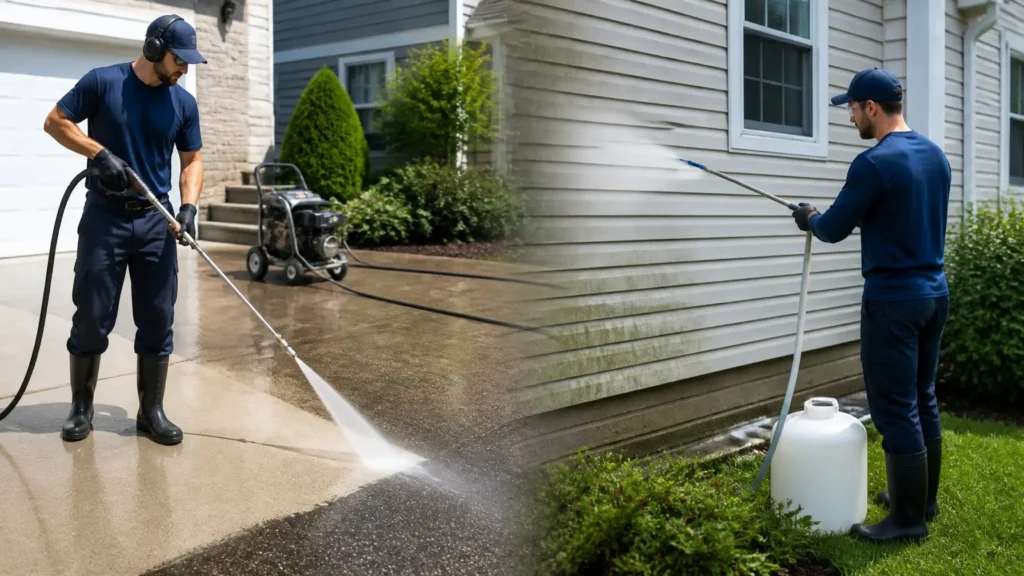
The important point is that soft washing is not simply pressure washing with the pressure turned down. It is a cleaning approach in which chemical selection, concentration, application, dwell, and rinsing become central parts of the process.
For crews that regularly work in this environment, BRS offers bleach-resistant pressure washing shirts intended for the demands of exterior-cleaning work.
How to Use Sodium Hypochlorite for Pressure Washing
There is no safe universal recipe for how to use sodium hypochlorite for pressure washing. A professional workflow should instead control the variables that determine how the chemical interacts with the surface.
1. Evaluate the surface
Identify the substrate before choosing chemistry or pressure.
Vinyl siding, painted siding, concrete, brick, stucco, asphalt shingles, wood and pavers do not have identical cleaning requirements.
Check for:
- oxidation
- loose paint or coatings
- damaged siding
- failing mortar
- unsealed or sensitive materials
- exposed metals
- landscaping
- nearby vehicles
- electrical components
- manufacturer restrictions
2. Identify the contamination
Determine whether the problem is algae, mold, mildew, dirt, grease, rust, mineral deposits, oxidation, or another contaminant.
Sodium hypochlorite is useful primarily for susceptible organic contamination. It is not the correct chemical for every stain.
3. Select an appropriate product
Check the product label, sodium hypochlorite concentration, SDS, intended uses and restrictions.
Do not assume two sodium hypochlorite products are interchangeable simply because both contain NaOCl.
4. Determine the required application strength
Consider:
- stock concentration
- substrate
- severity of organic growth
- application equipment
- injector or proportioner performance
- weather
- temperature
- sunlight
- required dwell
- product instructions
The concentration in your supply container is not necessarily the concentration reaching the wall or roof.
5. Protect surrounding property
Plan for overspray and runoff before application.
Sensitive vegetation, vehicles, metals, glass, adjacent coatings, outdoor furniture, electrical equipment and neighboring property may require protection or relocation.
6. Use compatible application equipment
Confirm that pumps, seals, hoses, injectors, fittings and tanks are approved for the chemical being used.
Do not assume the detergent tank on a pressure washer is safe for sodium hypochlorite.
For example, Simpson specifically warns against putting bleach through the detergent system on equipment covered by its guidance because caustic chemicals can damage injection components and pumps.
7. Apply in a controlled manner
Avoid uncontrolled overspray and unnecessary exposure. Follow the product and equipment manufacturer’s application instructions.
8. Allow appropriate dwell time
Give the chemistry time to work, while monitoring both the contamination and the substrate.
Do not assume that more dwell is automatically better.
9. Rinse as required
Rinsing requirements depend on the chemical product and surface. Remove residues where required and avoid driving water into areas not designed to receive high-pressure spray.
10. Inspect before repeating
Evaluate the result before automatically increasing concentration, pressure, or dwell.
A second controlled treatment may be safer than immediately escalating every variable at once.
Understanding 12.5% Sodium Hypochlorite for Pressure Washing
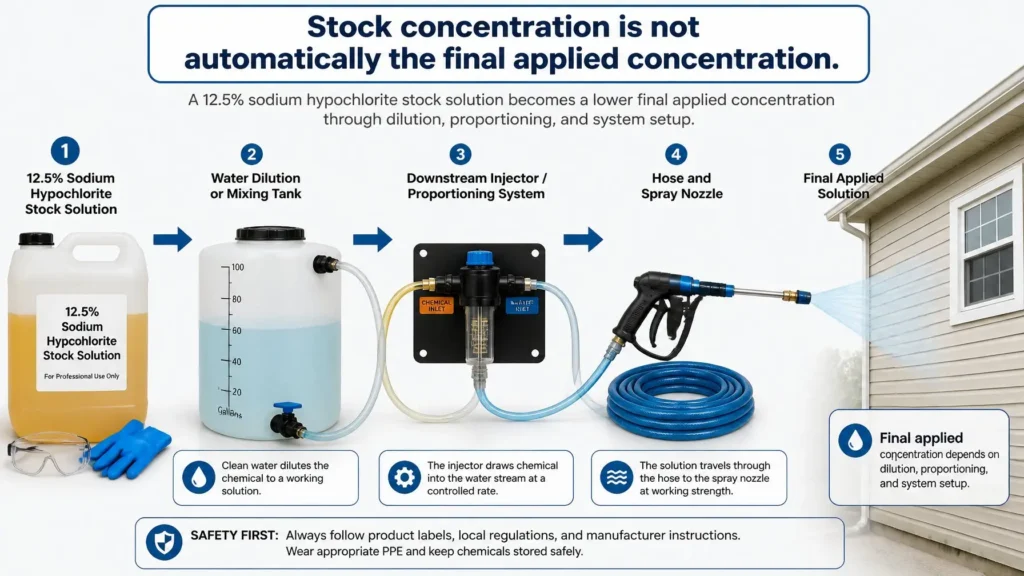
The phrase 12.5 sodium hypochlorite for pressure washing usually refers to sodium hypochlorite supplied at approximately 12.5% concentration.
Commercial products at this concentration exist; for example, current manufacturer documentation identifies 12.5% technical sodium hypochlorite products and classifies them as corrosive hazardous materials.
But one distinction is essential:
12.5% stock sodium hypochlorite does not mean the cleaned surface necessarily receives a 12.5% solution.
A professional system may begin with a 12.5% stock solution and then reduce its concentration through intentional tank dilution, downstream injection, proportioning, water flow, or another application method.
Stock strength is only the starting point
Imagine the chemical path as four stages:
Stock chemical → prepared mixture → equipment dilution → on-surface solution
Each stage can change the concentration.
A downstream injector, for example, draws chemical into a much larger water stream. A dedicated soft-wash system or proportioner can blend chemical and water differently.
The practical question is therefore not only:
“What percentage is in my chemical tank?”
It is:
“What concentration is actually being delivered by this system to this surface?”
That is why professionals should know the performance of their own equipment instead of copying an online mixing ratio from a different machine.
How to Mix Sodium Hypochlorite for Pressure Washing
The safest way to understand how to mix sodium hypochlorite for pressure washing is through concentration and system behavior, not a universal recipe.
For simple dilution calculations, professionals may encounter the concentration relationship:
C₁V₁ = C₂V₂
Where:
- C₁ = starting concentration
- V₁ = volume of stock solution
- C₂ = target concentration
- V₂ = final total volume
This equation explains mathematical dilution in a simple water-and-chemical mixture. It does not determine what concentration is safe or appropriate for a particular surface, and it does not automatically account for downstream injectors, proportioners, changing draw rates, hose configuration, or other equipment behavior.
The correct target must come from appropriate product, substrate and equipment guidance.
Before preparing a solution
Verify:
- The actual concentration of the stock product.
- The chemical label and current SDS.
- The substrate manufacturer’s cleaning guidance.
- The application equipment’s chemical compatibility.
- The intended delivery concentration or range.
- Whether additional dilution occurs inside the application system.
- Whether any surfactant or additive is specifically compatible with sodium hypochlorite.
Never mix sodium hypochlorite with acids or ammonia-containing cleaners. CDC guidance warns that incompatible mixtures can release dangerous gases.
What Is the Best Sodium Hypochlorite for Pressure Washing?
There is no single best sodium hypochlorite for pressure washing for every contractor, surface, or application.
A professional should evaluate:
- Concentration: Is the stock strength appropriate for the intended application system?
- Freshness: Sodium hypochlorite solutions can lose available chlorine during storage.
- Storage history: Heat and sunlight can contribute to degradation.
- Labeling: Is the concentration clearly identified?
- SDS availability: Can the supplier provide current safety documentation?
- Product consistency: Is the concentration reliable from purchase to purchase?
- Supplier reliability: Is inventory handled and rotated appropriately?
- Equipment compatibility: Can your application system safely handle the product?
- Intended use: Does the product labeling support the planned use?
- Surface requirements: What does the substrate manufacturer recommend?
ATSDR notes that sodium hypochlorite solutions are sensitive to conditions including heat and sunlight, reinforcing why storage and product age matter when evaluating chemical strength.
“Strongest available” and “best” are not synonyms.
Sodium Hypochlorite Concentration: Stock vs Applied Strength
This is one of the most important concepts in professional sodium hypochlorite cleaning.
| Term | What It Means | Why It Matters |
| Stock concentration | Strength in the original container | Starting point for calculations |
| Prepared/diluted concentration | Strength after deliberate mixing with water | May be what enters the application system |
| Injector ratio | Relationship between chemical draw and water flow | Can further reduce delivered strength |
| Downstream dilution | Dilution created when chemical is drawn downstream into the water stream | Stock percentage does not equal output percentage |
| Proportioner setting | Controlled blending of water, SH and compatible additives | Determines feed mixture |
| Final/applied concentration | Approximate strength leaving the application system | More relevant to treatment than stock strength |
| On-surface concentration | Chemical condition after reaching the substrate | Can be influenced further by wet surfaces, runoff and other field conditions |
This is why saying “we use 12.5%” without explaining the application system provides incomplete information.
A contractor using 12.5% stock through a downstream injector may deliver a substantially different solution from a contractor applying a separately prepared mixture through a dedicated soft-wash pump.
Where Is Sodium Hypochlorite Used?
Vinyl Siding
Sodium hypochlorite may be used to address algae, mildew and similar organic staining on compatible siding.
However, siding condition, oxidation, color, adjacent materials and manufacturer recommendations matter. Excessive pressure can also force water behind siding or damage the surface.
Use surface-specific guidance, test when appropriate, control overspray and rinse as required.
Concrete
Concrete often combines several contamination types: dirt, algae, mildew, oil, rust and other staining.
Sodium hypochlorite may help with organic growth, but it is not a universal answer for oil, grease, rust, mineral deposits or every other concrete stain.
Also consider nearby metals, vegetation, coatings, sealers and runoff.
Brick
Brick and masonry require attention to the brick, mortar, age, coatings, staining type and surrounding materials.
Do not assume a chemical appropriate for one masonry installation is appropriate for another. Acid-based masonry cleaners are especially important to keep completely separate from sodium hypochlorite because acids and hypochlorite are incompatible.
Stucco
Stucco can support biological staining, particularly in damp or shaded areas, but cleaning requires controlled chemistry and pressure.
Painted or coated stucco adds another variable because the coating itself may react differently from the underlying masonry.
Roofs
Roof cleaning is one of the clearest examples of why pressure and chemistry must be considered separately.
The Asphalt Roofing Manufacturers Association states that algae discoloration on roofing may be lightened using chlorine bleach and water, while emphasizing that mixing directions can vary among shingle manufacturers and that other cleaning methods should not be used without manufacturer approval.
Roof manufacturer guidance should therefore take priority over a generic online recipe.
Wood
Wood requires particular care because aggressive pressure can damage fibers, while chemical treatment can alter appearance and interact with stains or finishes.
Sherwin-Williams notes that properly proportioned sodium hypochlorite can remove mildew staining and surface mildew growth on wood, while also noting limitations.
Species, finish, condition and the desired final appearance should influence the cleaning process.
Painted Surfaces
Sodium hypochlorite may be useful against mildew on some compatible painted surfaces, but the paint system and condition must be evaluated first.
Sherwin-Williams publishes mildew-cleaning guidance that includes diluted household bleach for specified situations, protective equipment, thorough rinsing, and a warning not to add ammonia.
Benjamin Moore likewise advises protecting landscaping when exterior washing involves bleach or another cleaning solution.
These are examples of why coating-specific guidance should come before a generic exterior-cleaning formula.
Fences
Fence material can include bare wood, stained wood, painted wood, vinyl, composite material or metal.
Identify the material first. A process appropriate for a vinyl fence may not be appropriate for cedar or a painted fence.
Pavers
Sodium hypochlorite may help treat organic growth on compatible pavers, but contractors should consider paver material, joint sand, sealers, adjacent plants, metals and drainage.
The chemical problem and the surface problem should always be evaluated together.
Sodium Hypochlorite and Dwell Time
Dwell time is the period a cleaning solution remains on a surface so its chemistry can act before rinsing or the next cleaning step.
Adequate dwell can reduce the need for aggressive mechanical cleaning. But longer dwell is not automatically more effective or safer.
Dwell behavior changes with:
- chemical concentration
- surface temperature
- air temperature
- direct sunlight
- wind
- contamination load
- substrate
- surface moisture
- product formulation
Hot, sunny or windy conditions can cause a solution to dry faster.
Where product or surface instructions say not to let the solution dry, monitor the treated area and follow those directions. Do not substitute a universal internet dwell time for the chemical and substrate manufacturer’s instructions.
Can Sodium Hypochlorite Damage a Pressure Washer?
Yes, sodium hypochlorite can damage pressure-washer components that are not designed for it.
Potentially vulnerable parts include:
- pump components
- seals
- O-rings
- chemical injectors
- valves
- hoses
- fittings
- metal components
The exact risk depends on equipment materials, concentration, contact time and design.
Most importantly, do not assume that because a pressure washer can inject detergent, it can inject sodium hypochlorite.
Simpson’s published guidance, for example, specifically says not to use bleach in its detergent system and warns that bleach may damage soap-injection components and the pump. It also recommends flushing compatible detergent systems with clean water after use.
A dedicated chemical-resistant soft-wash system or properly configured downstream setup is fundamentally different from putting sodium hypochlorite into an incompatible pressure-washer detergent tank.
Follow your equipment manufacturer’s instructions.
Sodium Hypochlorite Safety for Pressure Washing
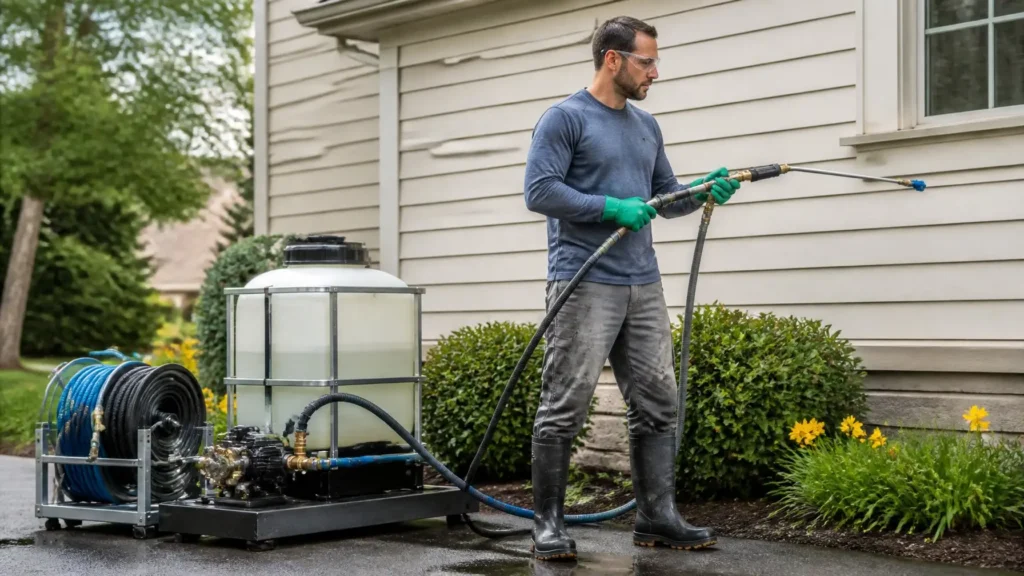
Professional exterior cleaning combines chemical exposure, pressurized water, outdoor conditions and property risks. Safety planning should begin before chemical preparation.
Wear appropriate PPE
Consult the specific product SDS to determine required PPE. Depending on the product and exposure scenario, this may include:
- chemical-resistant gloves
- eye or face protection
- protective work clothing
- suitable footwear
- additional protection specified by the SDS
A current SDS for a 12.5% sodium hypochlorite product classifies it as capable of causing severe skin burns and eye damage and warns against inhaling mist, vapor or spray.
Protect eyes and skin
Splashes can occur while transferring chemical, connecting hoses, priming pumps, spraying overhead surfaces or handling leaking fittings.
Eye protection and appropriate gloves should therefore be treated as core chemical-handling controls rather than optional accessories.
Control spray and ventilation
Avoid unnecessary mist and overspray. Indoor or enclosed applications require particular attention to ventilation and product instructions.
Protect plants and landscaping
Plan for vegetation before spraying.
Control overspray and runoff, follow chemical and surface guidance, and take appropriate measures to protect landscaping. Do not assume every plant responds the same way to chemical exposure.
Watch metals and vehicles
Hypochlorite can be corrosive to metals under relevant conditions. Avoid uncontrolled overspray on vehicles, hardware, fixtures, HVAC equipment and other sensitive components. CDC identifies corrosiveness to metals as one of the limitations of hypochlorites.
Manage runoff
Do not allow chemical runoff to enter locations where discharge is prohibited. Follow product labeling and applicable federal, state and local environmental requirements.
Store and label chemicals correctly
Keep sodium hypochlorite:
- in compatible containers
- clearly labeled
- secured from unauthorized access
- separated from incompatible materials
- stored according to the manufacturer’s instructions
Heat and sunlight can also affect sodium hypochlorite stability.
Critical chemical-mixing warning
Never mix sodium hypochlorite with acids, ammonia-containing products, or another chemical unless the manufacturer specifically confirms compatibility and the intended procedure.
Acids can cause hypochlorite solutions to release chlorine gas. Ammonia-containing compounds can create hazardous chloramine-related exposures. CDC documents both risks.
Do not rely on smell as a safety system.
Common Sodium Hypochlorite Pressure Washing Mistakes
- Assuming 12.5% stock strength equals applied strength.
Equipment and deliberate dilution can substantially change what reaches the surface. - Using one dilution for every surface.
Roofing, wood, siding, concrete and painted substrates have different requirements. - Ignoring the product label and SDS.
Concentration alone does not tell you everything about a chemical product. - Ignoring equipment compatibility.
A detergent injector is not automatically sodium-hypochlorite compatible. - Using excessive pressure to compensate for poor chemistry.
More pressure can damage substrates without addressing the actual cleaning problem. - Failing to rinse where rinsing is required.
Residue can continue interacting with surfaces and nearby materials. - Poor plant and property protection.
Overspray and runoff can travel beyond the intended cleaning area. - Allowing the solution to dry contrary to product guidance.
Sun, heat and wind can shorten the working window. - Mixing incompatible chemicals.
Hypochlorite plus acid or ammonia can create a serious inhalation hazard. - Using inadequate PPE.
Transfer, mixing and overhead application can expose workers to splashes and mist. - Poor chemical storage.
Heat, sunlight, contamination and incompatible storage can create safety and performance problems. - Ignoring environmental conditions.
Temperature, sunlight, wind and rain affect application behavior. - Treating every stain as organic growth.
Sodium hypochlorite is not the correct chemistry for every contaminant. - Increasing concentration before diagnosing the problem.
A stronger solution cannot fix the wrong chemical choice, faulty equipment or inappropriate technique.
Sodium Hypochlorite vs Sodium Hydroxide
These chemicals have different cleaning roles and should not be treated as interchangeable.
| Factor | Sodium Hypochlorite | Sodium Hydroxide |
| Formula | NaOCl | NaOH |
| Chemical type | Oxidizing chlorine compound | Strong alkali/base |
| Common cleaning role | Organic/biological contamination | Heavy grease, fats, oils and some stripping/degreasing applications |
| Often associated with | Algae, mildew, mold, biological staining | Degreasing and strongly alkaline cleaning |
| Main hazards | Corrosive exposure; dangerous incompatibility with acids/ammonia | Highly corrosive; severe chemical burns |
| Surface concerns | Metals, fabrics, coatings, plants and incompatible materials | Aluminum and other sensitive materials, coatings and many substrates |
| Selection principle | Choose when hypochlorite chemistry addresses the contaminant | Choose when strong alkaline chemistry is appropriate |
The lesson is simple: select chemistry according to the contaminant and substrate, not according to which chemical seems strongest.
Sodium Hypochlorite vs Household Bleach
Household chlorine bleach commonly contains sodium hypochlorite, but household bleach and professional chemical stock should not automatically be treated as equivalent.
Differences may include:
- sodium hypochlorite concentration
- formulation
- additives
- viscosity
- fragrance
- labeling
- intended use
- available SDS documentation
CDC notes that many household bleach products contain approximately 5%–9% sodium hypochlorite and warns that products such as some splashless formulations may not be suitable for purposes for which standard bleach is specified.
Professional cleaners should buy and use products based on verified concentration, documentation and intended application rather than the generic word “bleach.”
Does Sodium Hypochlorite Affect Pressure Washing Clothing?
Yes. Sodium hypochlorite can discolor or damage clothing, depending on concentration, exposure duration, fabric, dye, print, finish and repeated contact.
CDC specifically lists fabric discoloration or bleaching among the disadvantages of hypochlorites.
A pressure-washing crew can encounter more than chemical splash alone. A normal workday may expose clothing to:
- sodium hypochlorite overspray
- water
- surfactants and detergents
- dirt and grime
- sunlight and UV exposure
- heat
- sweat
- repeated laundering
That combination makes workwear selection a practical operating consideration rather than simply a branding decision.
BRS explains the fabric differences in its guide to polyester vs. cotton for work shirts and also addresses what actually happens when bleach contacts polyester.
One distinction should remain clear:
Bleach-resistant does not mean bleach-proof.
Bleach resistance is about improving performance under relevant exposure conditions. It is not permission to soak clothing in sodium hypochlorite or disregard PPE requirements. BRS discusses that distinction further in its guide to bleach-resistant vs. bleach-proof shirts.
What Should Pressure Washing Professionals Wear?
Pressure-washing workwear should be selected for the conditions crews actually face.
Useful characteristics include:
- moisture-wicking performance
- quick drying
- breathability
- durability
- freedom of movement
- suitability for repeated laundering
- performance around expected chemical splashes
- outdoor visibility where required
- professional branding
- consistent crew fit
For teams working around sodium hypochlorite, ordinary cotton shirts can become a recurring uniform problem because chemical splashes may discolor and degrade work clothing.
BRS’s custom pressure washing shirts are specifically positioned for pressure-washing crews and combine bleach-resistant performance with moisture-wicking fabric and custom branding. BRS also offers industry-specific custom uniforms for companies outfitting teams across different field-service roles.
Again, these garments are bleach-resistant, not bleach-proof, and they do not replace chemical PPE specified by an SDS or workplace risk assessment.
Outfitting a pressure-washing crew?
Explore BRS pressure-washing workwear, review the pressure washing shirt gallery for design ideas, or request a free custom mockup for your company branding.
Frequently Asked Questions
1. What is sodium hypochlorite used for in pressure washing?
Sodium hypochlorite is used primarily to chemically treat organic contamination such as algae, mold, mildew and related biological staining. It can supplement mechanical pressure washing and plays an especially important role in soft washing, where chemistry does more of the cleaning while surface pressure remains lower.
2. Is sodium hypochlorite the same as bleach?
Sodium hypochlorite is the active chlorine compound in many liquid chlorine bleach products, but “bleach” can describe products with different concentrations and formulations. Household products commonly have lower stock concentrations than some professional supplies, so the label and SDS should always be checked before use.
3. Can you use sodium hypochlorite in a pressure washer?
Only if the equipment manufacturer specifically allows the chemical and the relevant components are compatible. Do not pour sodium hypochlorite into a detergent tank simply because the machine can dispense soap. Some manufacturers, including Simpson in published guidance, specifically warn against using bleach in their pressure-washer detergent systems.
4. What is 12.5% sodium hypochlorite?
A 12.5% sodium hypochlorite product is a concentrated aqueous stock solution containing sodium hypochlorite at the concentration specified by its manufacturer. It is a starting chemical strength, not automatically the final strength delivered to a roof, wall, driveway or other surface. Commercial 12.5% products are available with specific SDS requirements.
5. Is 12.5% sodium hypochlorite safe for pressure washing?
That question cannot be answered from stock concentration alone. Suitability depends on the product, substrate, required final concentration, application equipment, dilution, environmental conditions and manufacturer instructions. A 12.5% stock product should never be assumed to be appropriate for direct, undiluted application to every exterior surface.
6. How do you use sodium hypochlorite for pressure washing?
First identify the substrate and contamination, then select an appropriate labeled product and determine the required application strength. Protect landscaping and adjacent property, use compatible equipment and PPE, apply in a controlled manner, observe the required dwell conditions, rinse as directed and inspect before repeating or increasing treatment.
7. How do you mix sodium hypochlorite for pressure washing?
There is no universal pressure-washing mix. Start with the verified stock concentration and determine the required delivered concentration from the product and surface guidance. Account for water dilution and any additional dilution caused by injectors or proportioning equipment. Never combine sodium hypochlorite with acids or ammonia-containing products.
8. What is the best sodium hypochlorite for pressure washing?
The best choice is a properly labeled product with a known concentration, current SDS, appropriate intended use, reliable supplier, suitable freshness and storage history, and compatibility with your application equipment. The strongest available sodium hypochlorite is not automatically the best choice.
9. What concentration of sodium hypochlorite is used for soft washing?
There is no single concentration appropriate for all soft-washing jobs. The required final concentration depends on the substrate, organic growth, stock strength, equipment, weather, dwell requirements and manufacturer instructions. Roofs, siding, painted surfaces and other materials should not automatically receive the same treatment.
10. Can sodium hypochlorite damage vinyl siding?
Improper chemical concentration, excessive dwell, incompatible additives or poor cleaning technique can damage or discolor materials associated with a siding installation. Verify the siding manufacturer’s cleaning instructions, evaluate adjacent metals and coatings, test where appropriate and use controlled application and rinsing.
11. Can sodium hypochlorite damage concrete?
Sodium hypochlorite can be useful for organic growth on compatible concrete, but concrete installations may include sealers, coatings, metals, decorative finishes and adjacent materials that require additional caution. It also does not solve every concrete stain; grease, rust and mineral staining may require different chemistry.
12. Does sodium hypochlorite kill mold and algae?
Sodium hypochlorite has antimicrobial and oxidizing activity and is used in products targeting algae, fungi, mildew and mold. Effectiveness depends on concentration, contact conditions, contamination and product directions. It should not be assumed that every visible dark stain is mold or algae.
13. Can sodium hypochlorite damage plants?
Chemical overspray or runoff can injure vegetation, particularly when exposure is significant. Pressure-washing professionals should plan plant protection before application, control overspray and runoff, and follow the chemical manufacturer’s environmental precautions rather than treating landscaping protection as an afterthought.
14. Can sodium hypochlorite damage pressure washer equipment?
Yes. Sodium hypochlorite can attack incompatible pumps, seals, injectors, fittings, hoses and metal components. Equipment should be specifically approved for the chemical and concentration being used. Some pressure-washer manufacturers explicitly prohibit bleach in their detergent systems.
15. How long should sodium hypochlorite dwell?
There is no universal dwell time for exterior cleaning. Appropriate dwell depends on product instructions, concentration, substrate, contamination, temperature, sunlight, wind and surface moisture. Follow product and substrate guidance and do not let a treatment dry when its instructions require it to remain wet or be rinsed.
16. What PPE should pressure washers use?
PPE should be selected from the chemical SDS and job-specific exposure assessment. Sodium hypochlorite work commonly requires appropriate eye protection, chemical-resistant gloves, protective clothing and suitable footwear, with additional controls where mist or respiratory exposure is possible. A 12.5% product can present serious skin and eye hazards.
17. Can sodium hypochlorite damage clothing?
Yes. Sodium hypochlorite can fade dyes, discolor fabric and damage some fibers, prints, finishes or blends. The outcome depends on fabric construction, concentration and exposure. Professionals who routinely work around bleach-based solutions may therefore benefit from workwear designed specifically for greater resistance to this environment.
18. Are bleach-resistant shirts bleach-proof?
No. Bleach-resistant shirts are not bleach-proof. Bleach-resistant workwear is designed to perform better under relevant chemical-exposure conditions, but prolonged, concentrated or extreme exposure can still affect garments. Chemical-resistant workwear also does not replace PPE required by the sodium hypochlorite SDS.
Final Takeaway
Sodium hypochlorite is valuable in pressure washing and especially soft washing because it provides a chemical means of treating algae, mold, mildew and other susceptible organic growth. But effective professional use depends on far more than the percentage printed on a chemical container.
A contractor needs to understand the complete path:
stock concentration → intentional dilution → application-system dilution → delivered concentration → surface conditions → dwell → rinse
That distinction is particularly important with 12.5% sodium hypochlorite for pressure washing. A 12.5% label describes the stock product; it does not automatically describe what should be applied to a building.
Identify the contamination, respect the substrate, understand the equipment, follow the label and SDS, protect workers and surrounding property, and never mix sodium hypochlorite with incompatible chemicals.
For the people doing that work every day, clothing is another part of the operating environment. Chemical splash, water, sun, sweat and repeated washing can be hard on ordinary uniforms. BRS provides bleach-resistant pressure washing workwear designed specifically for that environment, while maintaining the important distinction that bleach-resistant does not mean bleach-proof.