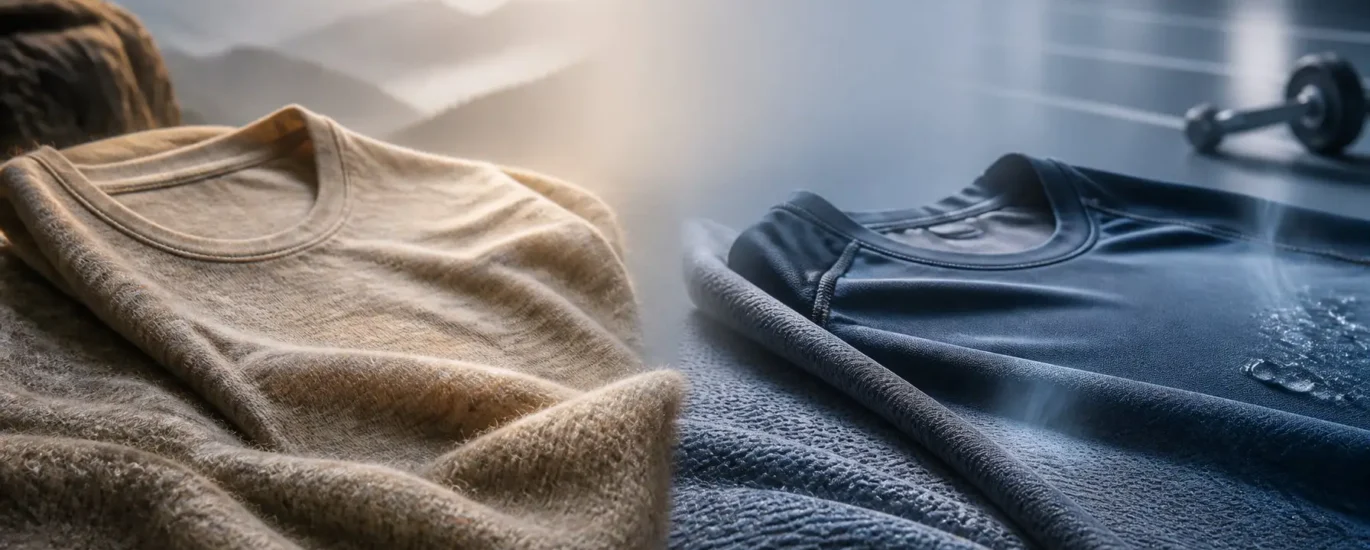
Neither merino wool nor polyester is universally better. Merino wool generally has an advantage when odor control, moisture buffering, next-to-skin comfort, and changing temperatures matter. Polyester usually has the advantage when fast drying, durability, frequent washing, easy care, and lower cost matter most. The right choice also depends on fabric weight, knit construction, fit, finishing, activity level, and environment.
For a traveler wearing one shirt repeatedly, merino may make more sense. For a runner sweating heavily in hot weather, lightweight performance polyester may be more practical. For a worker pressure washing outdoors around bleach-based cleaning solutions, the comparison changes again because chemical exposure, repeated washing, uniform durability, and branding become important.
Merino Wool vs Polyester at a Glance
| Feature | Merino Wool | Polyester |
| Fiber type | Natural animal/protein fiber | Synthetic fiber |
| Moisture behavior | Absorbs and buffers moisture vapor | Low fiber-level water absorption |
| Wicking | Depends on fabric construction | Can wick very effectively when engineered for it |
| Drying speed | Usually slower once substantially wet | Usually faster |
| Odor management | Generally strong | More prone to retaining body odor |
| Temperature regulation | Strong across changing conditions | Depends heavily on construction and layering |
| Warmth | Good insulation potential | Can also provide excellent insulation depending on construction |
| Breathability | Can be very comfortable across varying humidity | Can be highly breathable in lightweight/open constructions |
| Durability | Good, but fine/light merino can be abrasion-sensitive | Generally strong and durable |
| Comfort | Fine merino can be very soft | Smooth and lightweight; feel varies by fabric |
| Care | Usually requires more care | Generally easy to wash and dry |
| Cost | Usually positioned higher | Usually less expensive |
| Best uses | Base layers, travel, hiking, variable weather, repeated wear | Running, high-sweat activity, frequent washing, performance uniforms |
Polyester is described by Textile Exchange as strong, durable, crease-resistant, and quick drying. Wool has a much greater capacity to interact with moisture vapor and is widely used in apparel where temperature and moisture regulation matter.
The table is a general comparison rather than a guarantee about every garment. A lightweight open-knit polyester shirt and a thick polyester fleece behave very differently. The same applies to a fine merino running tee versus a heavy wool base layer. Research on performance textiles repeatedly shows that fiber composition is only one part of moisture and thermal performance.
What Is Merino Wool?
Merino wool is a natural protein fiber obtained from Merino sheep. Unlike the coarse wool many people associate with traditional sweaters, performance merino garments commonly use much finer fibers intended for next-to-skin clothing.
Its most interesting characteristic in performance apparel is how it interacts with moisture. Wool can take up moisture vapor within the fiber while also managing the microclimate between clothing and skin. This moisture-buffering behavior helps explain why merino is popular in base layers, hiking clothing, travel apparel, socks, and other garments worn through changing temperatures and activity levels.
Merino is also well known for odor management. Research summarized by Woolmark indicates that wool generally retains less body odor after wear than polyester. That does not mean a merino shirt never smells or never needs washing. It means odor buildup tends to be slower under comparable wear conditions.
Typical uses include:
- hiking and backpacking base layers
- cold-weather layering
- travel clothing
- running and outdoor apparel
- socks
- workwear where temperature regulation and odor management are priorities
Its disadvantages are practical. Merino garments are commonly more expensive, fine wool can be less abrasion-resistant than robust synthetics, and washing instructions may require greater care. Woolmark recommends following the garment’s care instructions and commonly recommends wool/gentle cycles and mild detergent for washable wool garments.
What Is Polyester?
Polyester is a synthetic fiber used extensively in sportswear, uniforms, outdoor apparel, and everyday clothing. Textile Exchange describes polyester as strong, durable, crease-resistant, and quick drying, which explains much of its popularity in performance garments.
A key distinction is that polyester absorbs relatively little water inside the fiber. Water can instead exist on the fiber surface and within the spaces in the fabric. Performance polyester can then use yarn shape, knit structure, capillary action, and sometimes finishing technologies to distribute moisture over the fabric surface.
That is why it is misleading to say that every polyester garment automatically “wicks sweat.” As BRS explains in its guide to why polyester dries faster, wicking and drying are separate processes, and construction determines how effectively a garment transports moisture.
Polyester is particularly common in:
- running shirts
- gym apparel
- team uniforms
- technical outdoor clothing
- work shirts
- sublimated custom apparel
- garments that undergo frequent washing
Merino Wool vs Polyester: Key Differences
 Which Is Better for Outdoor Work and Work Shirts
Moisture Wicking and Moisture Management
This is the area where fabric comparisons most often become confusing.
Absorption means moisture enters and is retained within a fiber.
Wicking means liquid moves through or across a fabric through capillary action.
Moisture transport describes how moisture moves through the clothing system.
Evaporation is the conversion of liquid moisture into vapor and its movement into the surrounding air.
Drying is the overall process of removing retained moisture from the garment.
Merino interacts with substantial moisture vapor inside the fiber. Polyester is much less absorbent at fiber level but can be engineered to transport liquid moisture efficiently across the fabric surface. Consequently, “absorbs more moisture” does not automatically mean “wicks better,” and “wicks better” does not automatically mean “dries faster.”
For someone sweating during a long run, a lightweight engineered polyester fabric may rapidly distribute sweat and encourage evaporation.
For someone hiking in changing temperatures with periods of exertion and rest, merino’s ability to buffer moisture and changing humidity can be valuable. Research on comparable-weight base layers has found advantages for wool in maintaining thermal comfort through stop-and-go activity.
Drying Speed
Polyester generally dries faster than merino wool once both become substantially wet.
Its low fiber-level water absorption means there is generally less moisture held inside the fiber that must later be released.
That does not mean every polyester garment beats every merino garment. Fabric thickness, total garment weight, knit density, airflow, temperature, humidity, and finishes all influence drying time.
The same principle is explained in BRS’s polyester drying guide: drying speed cannot be predicted from fiber name alone, even though polyester’s low water absorption creates a useful advantage.
Warmth and Temperature Regulation
Is merino warmer than polyester?
Not automatically.
Warmth depends heavily on how much insulating air a garment traps, which is affected by thickness, loft, knit, fabric weight, layering, wind, moisture, and garment design.
Merino’s advantage is better described as temperature and moisture buffering, especially under changing conditions. Wool can absorb moisture vapor and influence the microclimate around the body, and research on similar-weight garments has found wool particularly useful during activity/rest transitions.
Polyester can also make extremely warm clothing. Polyester fleece, insulated synthetic jackets, and heavy polyester base layers prove that fiber composition alone does not determine warmth.
For base layers, think about the entire clothing system rather than asking which raw fiber is “warmest.”
Odor Resistance
Merino has the clearer advantage here.
Research indicates that wool tends to retain less body odor after wear than polyester. Wool’s interaction with moisture and odor compounds contributes to this difference.
Polyester can develop noticeable odor during repeated high-sweat use, although results vary with fabric construction, washing, body chemistry, and any odor-control technology applied to the textile.
So the practical conclusion is:
Merino generally stays fresher through repeated wear, while polyester generally benefits from more frequent laundering after sweaty use.
Avoid claims that merino is “odor-proof.” It is not.
Breathability
“Breathability” should not be treated as a simple fiber ranking.
A lightweight mesh polyester running shirt may allow much more air movement than a dense merino jersey. Conversely, merino can provide excellent moisture-vapor management and comfort under changing temperature and humidity.
Fabric weight, knit openness, thickness, yarn construction, fit, and finishing can therefore matter as much as the fiber itself. Performance-textile research supports evaluating finished fabric construction rather than assuming moisture and thermal properties from raw material alone.
Durability
Polyester generally has the edge for repeated washing, abrasion, and demanding everyday use. Textile Exchange identifies strength and durability among polyester’s core characteristics.
Fine merino can perform well for normal wear but may be more vulnerable to abrasion, pilling, or damage in high-friction situations. This is one reason some performance garments blend merino with synthetic fibers.
For workwear, durability matters differently than it does for recreational hiking. Crews may wear the same uniform repeatedly, wash it several times each week, brush against equipment and surfaces, and require consistent appearance across many employees. Those requirements often strengthen the case for polyester-based performance fabrics.
Comfort
Fine merino is valued for its soft next-to-skin feel and ability to remain comfortable across changing conditions.
Polyester can also feel extremely comfortable when made into lightweight, smooth, well-ventilated performance fabrics.
Personal preference matters here. Some people prefer the dry, light feel of synthetic athletic fabric. Others prefer merino because it feels less clammy as environmental conditions change.
Fit and construction often matter more than marketing terminology.
Care and Washing
Polyester is generally simpler to maintain. It tolerates frequent routine washing well and dries quickly.
Merino requires greater attention to the garment’s care label. Many washable wool garments can be machine washed, but gentle cycles and suitable detergents are commonly recommended.
If you need uniforms that rotate through constant wear-and-wash cycles, polyester’s ease of care is a significant practical advantage.
Cost
Merino wool generally occupies a higher price tier than polyester because of raw-material and processing differences.
Polyester is widely available across everything from low-cost athletic shirts to sophisticated technical fabrics, making it easier to manufacture performance garments at many price points.
Rather than comparing price alone, compare price against the job the garment must do.
A traveler may value paying more for reduced odor during repeat wear. A large work crew may prioritize durable uniforms that can be washed constantly and replaced economically.
Merino Wool vs Polyester Base Layer: Which Is Better?
There is no universal winner for a merino wool vs polyester base layer comparison.
| Situation | Better Starting Point | Why |
| Stop-and-go cold-weather activity | Merino | Moisture buffering and thermal comfort |
| Multi-day hiking/travel | Merino | Better odor management |
| High-output activity | Polyester | Fast drying |
| Very sweaty workouts | Polyester | Low absorption and rapid moisture release |
| Frequent washing | Polyester | Easy care and durability |
| Variable temperatures | Merino | Comfortable across changing conditions |
| Lowest upfront cost | Polyester | Generally more affordable |
Research comparing similar-weight base layers supports merino for dynamic “stop-go” conditions, where activity is followed by rest. Polyester remains highly useful when fast moisture release and drying are priorities.
A good base layer should also match the rest of the clothing system. Your mid layer handles additional insulation, while the outer layer manages wind or precipitation. The base layer’s role is primarily next-to-skin comfort and moisture management, not simply “keeping you warm.”
Merino Wool vs Polyester for Running
For running, the better choice depends on how far, how hard, and in what weather.
Short-Distance and High-Intensity Running
Lightweight performance polyester is usually the practical choice when the priority is rapid moisture movement, minimal wet weight, quick drying, and easy washing after every session.
Long-Distance Running
For merino wool vs polyester for long-distance running, there is more of a tradeoff.
Polyester is attractive for races or hot-weather sessions where fast drying matters most.
Merino becomes more appealing when odor management, long-duration comfort, cooler conditions, travel, or repeat wear matter more than achieving the fastest possible drying time.
Some runners therefore prefer merino or merino-synthetic blends for long training days while using lightweight polyester for hot races.
Hot-Weather Running
A lightweight, open polyester knit is often the stronger starting point for very sweaty hot-weather running.
Do not assume the word polyester alone guarantees comfort, though. A dense polyester fabric can still feel hot and clammy. Construction remains critical.
Cold-Weather Running
Merino can be particularly useful when the runner alternates between hard efforts, slow sections, and stops because its moisture-buffering behavior can help moderate the rapid change in thermal sensation associated with activity and rest.
Polyester vs Merino Wool vs Nylon for Running
Nylon is another synthetic fiber widely used in activewear and technical apparel. It is often chosen where strength, abrasion performance, stretch-compatible construction, or reinforcement matters.
| Property | Merino Wool | Polyester | Nylon |
| Moisture behavior | Absorbs/buffers vapor | Low absorption; strong engineered moisture transport | Synthetic; performance depends on construction |
| Drying | Moderate | Usually fast | Generally fast |
| Odor control | Strong | Usually weaker | Usually weaker than merino |
| Durability | Moderate | High | High |
| Comfort | Soft in fine grades | Smooth/light | Smooth and strong |
| Typical running role | Base layers, cool weather, endurance/repeat wear | Running tees, hot weather, racing | Blends, tights, abrasion-prone areas |
For someone researching polyester vs merino wool vs nylon for running moisture wicking, the useful takeaway is that fiber selection alone is incomplete. Polyester and nylon are common in engineered performance garments, while merino manages moisture differently through vapor absorption and buffering. Yarn, knit, garment fit, weight, and blends can change the result dramatically.
Which Is Better for Outdoor Work and Work Shirts?

The priorities change when the clothing is worn for a job rather than a workout.
A runner may wear a shirt for 60 minutes before putting it in the laundry. A landscaping, cleaning, or pressure-washing employee might wear a uniform through a full outdoor shift involving sweat, dirt, equipment, repeated movement, washing, customer interaction, and potentially cleaning chemicals.
That makes several factors more important:
- fast drying
- repeated-wash durability
- lightweight construction
- moisture management
- consistent appearance
- customization and branding
- replacement cost
- the specific chemicals encountered on the job
BRS’s guide to work shirts for hot weather similarly emphasizes lightweight construction, moisture management, drying speed, durability, and job-specific requirements instead of identifying one universal “coolest” fabric.
For landscaping and other outdoor crews, BRS also offers custom landscaping work shirts built around lightweight, moisture-wicking workwear for long outdoor shifts.
Merino can absolutely function as workwear, particularly where temperature regulation and odor management are important. Woolmark documents merino applications in modern workwear as well.
But where frequent laundering, abrasion, custom sublimation, crew-wide consistency, and cost matter heavily, polyester often becomes the more practical uniform material.
What Fabric Is Best for Pressure Washing?
Pressure washing introduces a factor that a normal running-shirt comparison does not: chemical exposure.
Crews may work in heat and humidity while dealing with water, sweat, dirt, overspray, and bleach-based solutions. Consequently, a good pressure-washing shirt needs more than generic athletic performance.
Useful characteristics include:
- lightweight construction
- moisture management
- quick drying
- durability through frequent washing
- appropriate long- or short-sleeve coverage
- professional branding
- fabric and coloration suited to expected bleach exposure
It is especially important not to conclude that all polyester is bleach-resistant.
BRS’s own guide, Does Bleach Stain Polyester?, explains that bleach can discolor some polyester garments depending on factors including dye, concentration, exposure time, printing method, color, and fabric blend.
Purpose-built workwear therefore needs to be evaluated as a finished garment, not simply by reading “100% polyester” on the label.
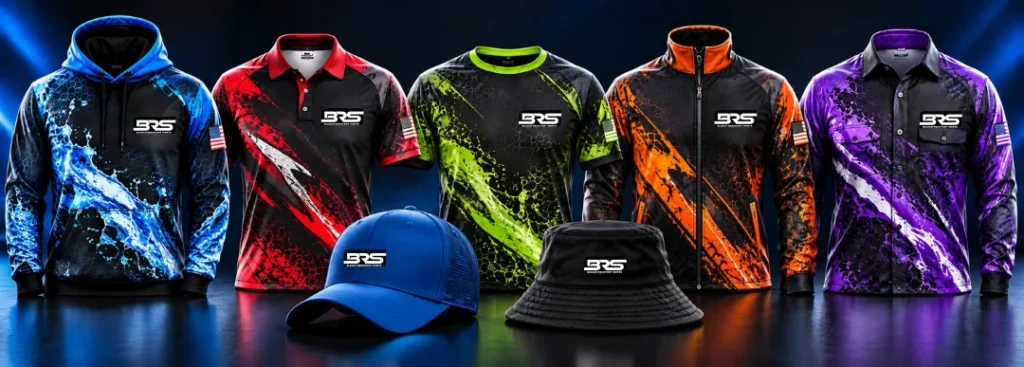
BRS specializes in custom bleach-resistant pressure washing shirts made from polyester performance fabric and promotes moisture-wicking construction, sublimated customization, and workwear designed for bleach-exposed environments. The company also explicitly distinguishes bleach resistance from being completely bleach-proof.
There is another safety distinction worth making: bleach-resistant work shirts are not chemical-protective PPE. BRS’s pressure-washing clothing guide states that workers handling strong cleaning solutions should still follow chemical-product instructions and use appropriate safety equipment.
For a deeper job-specific overview, see BRS’s guide to what to wear when pressure washing.
Merino Wool vs Polyester: Which One Should You Choose?
Choose merino wool when you care most about:
- odor management
- changing temperatures
- multi-day or repeat wear
- soft next-to-skin comfort
- hiking and travel
- stop-and-go outdoor activity
- a natural-fiber garment
Choose polyester when you care most about:
- faster drying
- heavy sweating
- frequent washing
- abrasion and durability
- easy care
- lower upfront cost
- technical running shirts
- team uniforms and performance workwear
For chemical-heavy jobs, do not make the choice based on merino versus polyester alone. Evaluate the actual garment, dye/printing system, manufacturer claims, chemical exposure, laundering requirements, and required PPE.
For pressure-washing and outdoor-service businesses specifically, BRS offers custom performance workwear through its Design Your Custom Gear process, including a free digital mockup before production.
Frequently Asked Questions
Is merino wool better than polyester?
Neither is better for every use. Merino generally has advantages in odor management, moisture buffering, repeat wear, and changing temperatures. Polyester is generally stronger for quick drying, frequent washing, durability, easy care, and cost. The finished fabric’s weight and construction can change the comparison substantially.
Is polyester warmer than merino wool?
Fiber type alone does not determine warmth. Fabric thickness, loft, knit structure, trapped air, layering, wind, and moisture all affect insulation. Merino is particularly effective at regulating comfort across changing moisture and temperature conditions, while polyester can also be engineered into extremely warm garments.
Which is better for a base layer, merino or polyester?
Merino is often preferable for variable temperatures, multi-day wear, odor control, and stop-and-go outdoor activity. Polyester is often preferable for intense exercise, heavy sweating, quick drying, frequent washing, and lower cost.
Does merino wool wick moisture?
Merino manages moisture effectively, but describing the process only as “wicking” is incomplete. Wool absorbs moisture vapor within the fiber and can also transport moisture through the fabric. The exact liquid-wicking performance depends on yarn, knit, finishing, and construction.
Does polyester dry faster than merino wool?
Usually, yes. Polyester absorbs relatively little water within its fibers, so a lightweight polyester garment typically has less internally retained moisture to release. Exact drying time still depends on fabric weight, knit, temperature, humidity, airflow, and garment construction.
Which fabric smells less?
Merino wool generally retains less body odor during wear than polyester. This makes it particularly useful for travel, hiking, and repeat wear. It is not odor-proof, however, and still needs laundering.
Is merino wool good for running?
Yes. Merino can work particularly well for long training sessions, cool weather, variable temperatures, travel, and runners who prioritize odor control. For very hot or high-sweat running, lightweight polyester may dry faster.
Is polyester good for running?
Yes. Polyester is widely used in running apparel because it can be lightweight, durable, quick-drying, and highly effective at moisture transport when the fabric is engineered correctly.
Which is more durable, merino or polyester?
Polyester generally has the advantage for abrasion, frequent washing, and demanding everyday use. Fine merino can still last well with appropriate care, but lightweight wool garments can be more sensitive to friction and laundering.
What is the best fabric for work shirts?
It depends on the work environment. For physically demanding jobs involving heat, sweat, repeated washing, and daily wear, lightweight performance polyester is often practical. For jobs prioritizing temperature regulation and odor management, merino may also be useful. Evaluate the finished garment rather than fiber composition alone.
What is the best fabric for pressure washing shirts?
Pressure-washing shirts should prioritize moisture management, drying, durability, professional appearance, and suitability for the chemicals used on the job. Purpose-built bleach-resistant performance polyester can be more appropriate than ordinary athletic clothing, but the garment should not be treated as chemical PPE.
Is polyester bleach resistant?
Not automatically. Bleach can discolor or damage some polyester garments depending on dye, color, concentration, contact time, printing process, and fabric construction. Purpose-built bleach-resistant polyester workwear is different from assuming that every polyester shirt can tolerate chlorine bleach.