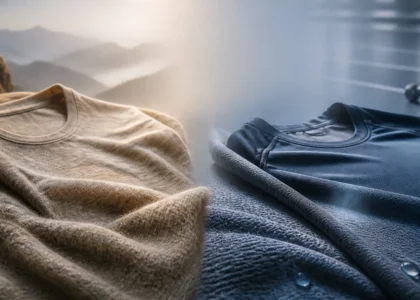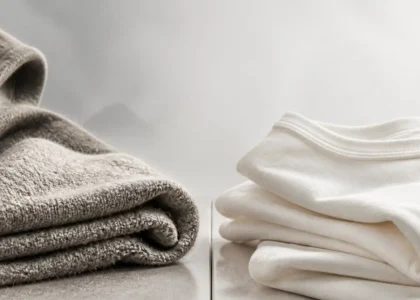
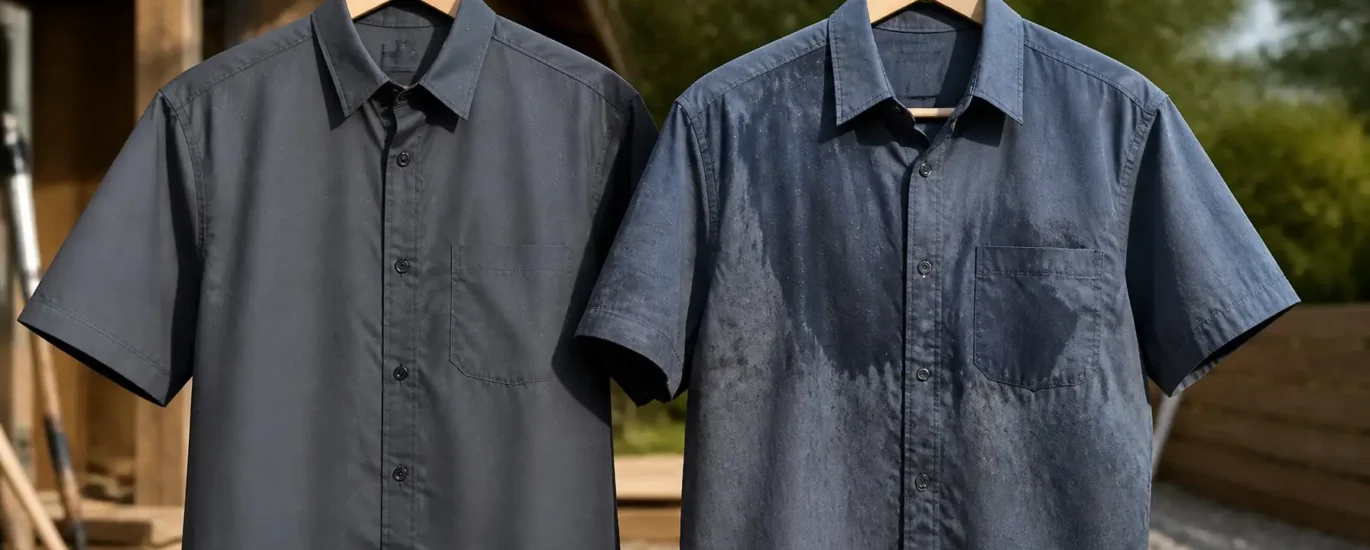
Yes, polyester generally dries faster than cotton under similar conditions. Polyester fiber absorbs very little water compared to cotton, so there’s simply less moisture trapped inside the fabric that needs to evaporate.
Cotton is a natural fiber built to soak up water. Polyester is a synthetic fiber built to resist it. That single difference in fiber structure explains most of the drying-time gap you feel between a cotton work shirt and a polyester one after a sweaty shift or a wash cycle.
That said, “polyester dries faster” isn’t a rule that applies the same way in every situation. Fabric weight, weave, garment construction, humidity, airflow, and how much moisture the fabric is holding in the first place all affect real-world drying time. A heavy polyester fleece can still take longer to dry than a lightweight cotton undershirt. The fair way to say it is this: polyester generally dries faster than cotton when comparing similar lightweight garments under similar conditions. For a broader side-by-side look at how the two fabrics compare on comfort, durability, and bleach resistance, our polyester vs cotton comparison covers the full picture. This article focuses specifically on the drying-speed question and the science behind it.
Why Does Polyester Dry Faster Than Cotton?
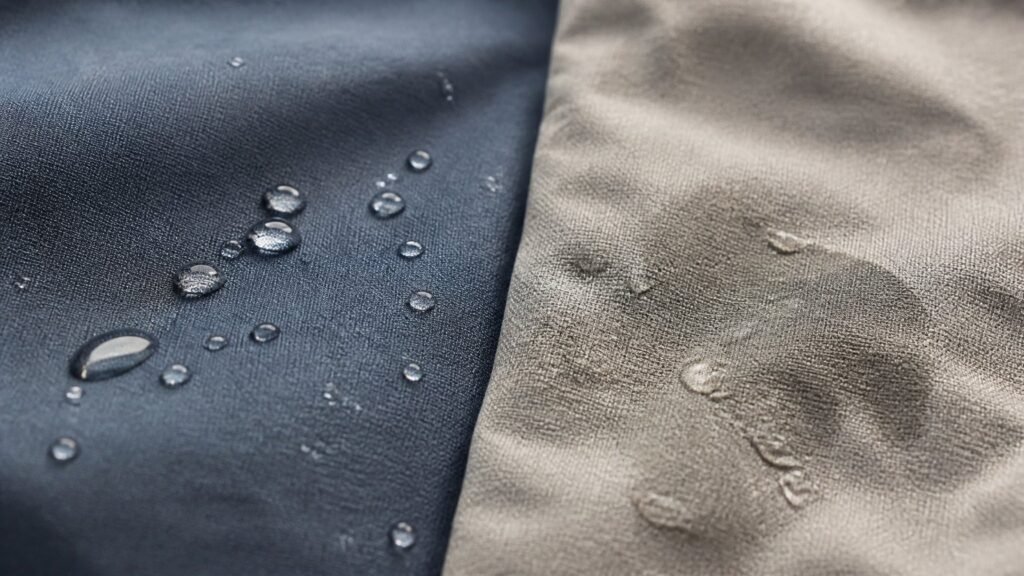
The drying-speed gap comes down to four connected ideas: absorption, moisture retention, evaporation, and wicking. Understanding how these work together explains why one fabric feels dry within an hour while the other stays damp for most of a shift.
Polyester Absorbs Less Water
Polyester is a synthetic fiber made from long-chain polymers, and those polymer chains simply don’t have much affinity for water molecules. Textile scientists describe this using “moisture regain,” a standard measure of how much water a fiber absorbs relative to its own dry weight under set conditions. Polyester’s moisture regain sits at roughly 0.4%, while cotton’s sits closer to 7-8% a difference of well over an order of magnitude.
In practical terms, that means a soaked polyester shirt is mostly holding water on its surface and in the spaces between fibers, not inside the fibers themselves. Surface water evaporates far more easily than water that has been absorbed into a fiber’s internal structure.
Cotton Holds More Moisture
Cotton fiber is built almost entirely from cellulose, a natural polymer with a chemical structure full of hydroxyl groups that readily bond with water molecules. That’s exactly why cotton feels soft, breathable, and comfortable against skin, and it’s also why cotton behaves like a sponge once it’s wet.
When cotton absorbs sweat or water, the moisture doesn’t just sit on the surface. It’s pulled into the fiber itself, which is why a soaked cotton shirt feels noticeably heavier than a dry one. All of that internally absorbed moisture has to work its way back out and evaporate before the shirt feels dry, and that process takes time.
Evaporation Is the Key to Drying
Drying is not just about pulling moisture away from the skin. A shirt is only “dry” once the water in it, wherever it’s located, has evaporated into the surrounding air. Evaporation depends on exposed surface area, airflow, temperature, and humidity, and it happens fastest when moisture is sitting at or near the fabric surface rather than buried deep inside the fiber.
This is the core reason polyester has an advantage. Because polyester fiber holds so little water internally, more of the total moisture in a wet polyester shirt sits close to the surface, exposed to air, ready to evaporate. Cotton’s internally absorbed moisture has to migrate to the surface first, adding an extra step and extra time to the process.
Wicking and Drying Are Not the Same Thing
This distinction matters more than most people realize. Wicking and drying describe two different jobs a fabric can do:
- Wicking = moving moisture across or through the fabric, usually away from the skin toward the outer surface, using capillary action between fibers.
- Drying = removing that moisture from the fabric altogether through evaporation.
A fabric can be engineered to wick moisture extremely well without necessarily being the fastest-drying fabric available, and the reverse is also true. Polyester’s low absorption gives it a natural drying advantage, but a shirt only wicks efficiently if it’s also engineered with the right knit structure, yarn spacing, or surface treatment to actively move moisture outward. Polyester fiber composition alone shouldn’t automatically be equated with strong moisture-wicking performance that performance comes from how the fabric is built, not just what it’s made of. This is the same distinction covered in our guide to moisture-wicking work shirts, where fabric construction plays as big a role as fiber type.
Polyester vs Cotton: Which Dries Faster?
Polyester vs Cotton Drying Comparison
| Feature | Polyester | Cotton |
| Water absorption | Generally lower | Generally higher |
| Drying speed | Generally faster | Generally slower |
| Moisture retention | Lower | Higher |
| Sweat management | Can be excellent when engineered for wicking | Absorbs sweat and holds it |
| Wet weight/feel | Usually lighter when wet | Can feel noticeably heavier |
| Best use | Active work, hot climates, heavy sweating | Casual or low-intensity wear, mild conditions |
Nothing in this table should be read as an absolute. Fabric weight and construction can shift real-world results a thick, dense polyester garment can dry slower than a thin, loosely woven cotton one. But when you compare similar lightweight garments in similar conditions, polyester’s lower water absorption consistently gives it the drying-speed edge.
Does Polyester Dry Faster After Washing?
Generally, yes a washed polyester shirt typically comes off the line or out of the dryer sooner than a washed cotton shirt of similar weight. The reason is the same as above: polyester retains less water after the spin cycle because its fibers never absorbed much water to begin with.
Real drying time after washing depends on several variables:
- Fabric thickness: thicker garments hold more total water regardless of fiber type
- Garment construction: tighter weaves and knits with less airflow slow drying
- Temperature: warmer air speeds up evaporation
- Airflow: moving air removes evaporated moisture from the fabric surface faster than still air
- Humidity: humid air slows evaporation for any fabric
- How much water the fabric retained after washing/spinning
- Drying method: machine drying, line drying, and flat drying all perform differently
We won’t cite specific drying times like “polyester dries in two hours and cotton takes six,” because those numbers depend entirely on the exact conditions of a given wash and dry cycle, and no single figure holds true across different machines, climates, and fabric weights. What’s consistent is the relative comparison: under the same washing and drying conditions, polyester reliably finishes drying sooner than cotton.
Does Polyester Dry Faster From Sweat?
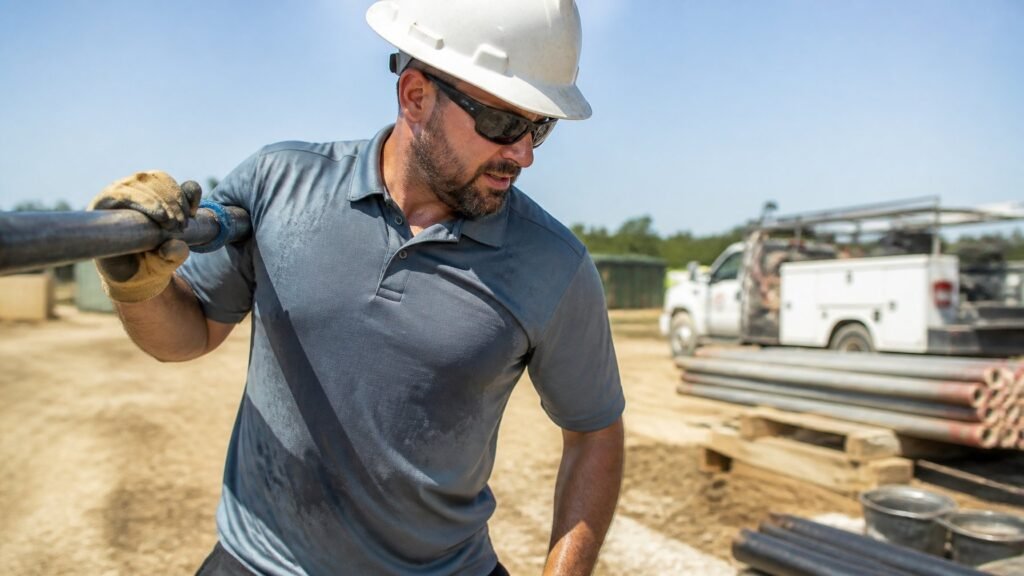
Yes, and this is where the difference is often most noticeable during a workday. Here’s the general sequence: sweat is produced at the skin, it moves onto or into the fabric, and it then needs to evaporate for the wearer to feel dry again.
With cotton, sweat gets absorbed into the fiber and stays there, which is why a cotton work shirt often feels damp and heavy well after the physical activity has stopped. With performance polyester, sweat has much less opportunity to be absorbed into the fiber itself. Performance polyester can be engineered to move moisture away from the skin and spread it across the fabric surface, where it can evaporate more readily. That combination low absorption plus engineered wicking is why polyester-based performance fabrics are so common in workwear built for heavy sweating.
It’s worth repeating that not every polyester shirt is automatically moisture-wicking. A cheap, tightly woven polyester shirt with no wicking treatment can still trap sweat against the skin and feel clammy. The fiber gives polyester a drying-speed advantage; the construction is what determines whether that advantage translates into real comfort during a sweaty shift.
Does Polyester Dry Faster in Humid Weather?
Polyester can still dry faster than cotton in humid weather, but humidity slows evaporation for both fabrics. The reason is straightforward: the air already contains a large amount of water vapor, which reduces how much additional moisture the air can absorb from a wet fabric. Evaporation happens more slowly when the surrounding air is already close to saturated.
Because polyester holds less water to begin with, it still generally has less total moisture to evaporate than a comparable cotton garment, so its relative advantage tends to hold up even in muggy conditions. But workers in high-humidity climates should expect longer drying times across the board for both fabrics compared to hot, dry conditions where evaporation happens much faster.
What Makes a Polyester Shirt Dry Quickly?
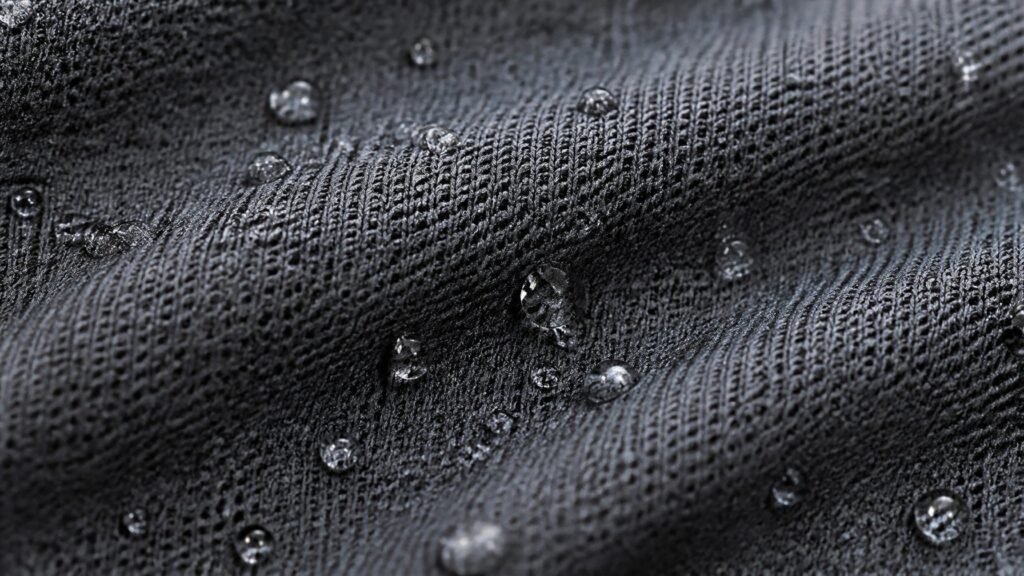
Fiber type is only one part of the equation. A handful of construction and environmental factors determine how quickly any given polyester shirt actually dries in the real world.
Fabric weight. Lightweight fabric contains less total material, which generally means less moisture is retained and less needs to evaporate. Our lightweight work shirts are built around this principle for jobs where fast drying matters most.
Fabric construction. Knits, weaves, mesh panels, and ventilation zones all influence how easily air moves through the fabric and how effectively moisture is carried to the surface where it can evaporate.
Moisture-wicking design. Engineered performance fabrics use specific yarn structures and sometimes surface treatments to actively move moisture away from the skin and spread it across a larger surface area, speeding up evaporation.
Airflow. More air movement around and through the fabric increases the rate of evaporation, which is one reason a shirt dries faster on a breezy day than in a still, closed room.
Temperature. Warmer conditions generally speed up evaporation, though humidity still plays a major role alongside temperature.
Humidity. As covered above, higher humidity slows evaporation regardless of fabric type.
Why Does Cotton Take Longer to Dry?
Cotton’s slower drying time comes back to the same fiber-level explanation. Cotton is highly absorbent by nature, so moisture is drawn into and retained within the fiber itself, not just held on the surface. Wet cotton can become noticeably heavier than dry cotton because of how much water the fibers are holding.
All of that internally retained moisture has to migrate back out to the fabric surface before it can evaporate, and that migration process simply takes more time than evaporating surface moisture. In humid conditions, that process slows down even further, which is why a soaked cotton shirt can stay damp for hours in muggy weather.
Is Polyester Better Than Cotton for Hot Weather?
There’s no universal answer here it depends on the work and the person wearing the shirt. Performance polyester tends to be more practical for:
- Heavy sweating
- Physical labor
- Outdoor work in direct sun
- Hot, humid conditions
- Long shifts where staying dry matters for comfort and safety
- Any situation where fast drying between activity or between wash cycles is a priority
Cotton still has a place, and some people genuinely prefer it for:
- Softness and natural hand-feel
- Low-intensity activity or indoor, climate-controlled environments
- Casual wear where drying speed isn’t a factor
For crews spending full shifts outdoors, our guide to summer work shirts goes deeper into fabric choices built specifically for heat and sun exposure.
Is Polyester Good for Work Shirts?
Fast drying is only one piece of why polyester shows up so often in workwear. Taken together with its other properties, it’s easy to see why so many uniform programs default to polyester or polyester-blend shirts:
- Quick drying between sweat exposure and wash cycles
- Effective moisture management when engineered with a wicking construction
- Strong durability through repeated industrial washing
- Lightweight construction that reduces fatigue over a long shift
- Consistent performance across outdoor conditions and physical activity
None of that means polyester is automatically the right choice for every job. Indoor roles with minimal physical exertion may not need the same drying performance that an outdoor crew does. But for jobs involving sweat, sun, and repeated washing, quick-drying polyester construction solves a real, everyday comfort problem.
Polyester vs Cotton for Different Work Conditions
Which Fabric Makes Sense for Different Conditions?
| Work Condition | Better-Suited Fabric | Why |
| Heavy sweating / physical labor | Polyester (moisture-wicking) | Lower absorption plus engineered wicking keeps skin drier |
| Outdoor work in hot, sunny climates | Polyester | Faster evaporation and lighter wet-weight feel |
| Hot and humid conditions | Polyester | Retains less moisture even when evaporation slows for both fabrics |
| Indoor, climate-controlled environments | Either, depending on preference | Lower sweat volume reduces the drying-speed advantage |
| Frequent industrial washing | Polyester | Holds up better to repeated wash cycles without breaking down |
| Low-intensity or casual settings | Cotton | Softness and breathability matter more than dry time |
Jobs like landscaping and lawn care involve a mix of sun exposure, sweat, and physical movement, which is why moisture management is such a common theme across our landscaping work shirts. Mechanics and automotive techs face similar demands, often combined with heat from engine bays and shop floors, which is part of why quick-drying fabric shows up throughout our mechanic work shirts as well.
How to Make Work Shirts Dry Faster
Regardless of fabric, a few practical habits can shave real time off drying, whether you’re air-drying after a shift or running shirts through a machine:
- Improve airflow around damp shirts instead of stacking them in a pile
- Spread garments out fully when air drying rather than letting them bunch or overlap
- Follow the garment’s actual care label rather than guessing at wash settings
- Avoid excessive fabric softener, since it can coat performance fibers and interfere with moisture-wicking finishes
- Choose lightweight fabric construction when fast drying between shifts is a priority
- Hang shirts in a well-ventilated space rather than a closed, humid room
None of these tips override fiber science a heavy cotton shirt with great airflow can still dry slower than a lightweight polyester shirt with poor airflow. But good habits meaningfully speed up drying time within whatever fabric you’re working with.
Frequently Asked Questions
Does polyester dry faster than cotton?
Yes. Polyester generally dries faster than cotton because its fibers absorb far less water, leaving less moisture that needs to evaporate.
Why does polyester dry faster than cotton?
Polyester fiber has very low moisture absorption compared to cotton’s highly absorbent cellulose structure. Less water gets pulled inside the fiber, so more moisture stays near the surface where it can evaporate quickly.
Does polyester absorb less water than cotton?
Yes, significantly less. Polyester’s moisture regain is roughly 0.4%, while cotton’s is closer to 7-8%, meaning cotton fiber absorbs many times more water relative to its weight.
Does polyester dry faster after washing?
Generally, yes. A washed polyester shirt typically finishes drying sooner than a similar cotton shirt because it retains less water after the wash and spin cycle, though exact times vary with fabric weight, airflow, and drying method.
Does polyester dry faster from sweat?
Yes. Sweat has less opportunity to soak into polyester fiber, and performance polyester can be engineered to move sweat to the fabric surface, where it evaporates more readily than sweat trapped inside cotton fiber.
Does polyester dry faster in humid weather?
Polyester generally still dries faster than cotton in humid weather, though humidity slows evaporation for both fabrics since the air already holds more water vapor.
Is polyester better than cotton for hot weather?
For heavy sweating, physical work, and outdoor heat, performance polyester is usually more practical. Cotton can still be preferred for softness and comfort in mild, low-activity settings.
Is polyester good for work shirts?
Yes, especially for jobs involving sweat, sun exposure, and frequent washing. Quick drying, durability, and moisture management make it a practical choice for daily workwear.
Does moisture-wicking polyester dry faster?
Moisture-wicking polyester is engineered to move sweat to the fabric surface, which supports faster evaporation on top of polyester’s naturally low water absorption, making it especially effective for heavy sweating.
Which fabric is better for sweaty work?
Polyester, particularly moisture-wicking polyester, tends to perform better for sweaty work because it holds less moisture and dries faster than cotton, which absorbs sweat and stays damp for longer periods.