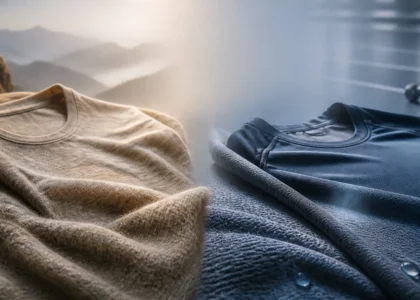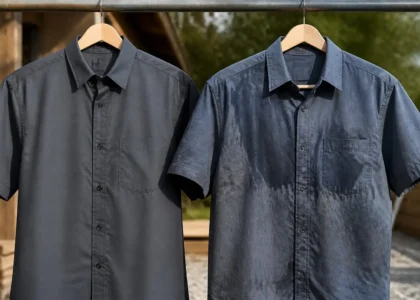
Merino wool and cotton are both natural fibers, but they behave very differently once heat, sweat, moisture and repeated wear enter the picture. Merino wool generally offers stronger moisture-vapor management, odor control and insulation across changing temperatures. Cotton is soft, familiar, absorbent, widely available and often practical for casual everyday wear.
Neither is universally better. A lightweight cotton T-shirt can be comfortable on a relaxed summer day, while a merino shirt may make more sense for hiking, travel, layering or activities where repeated wear and moisture management matter. For demanding professional work, other factors such as durability, frequent washing, garment construction and chemical exposure may matter more than choosing between these two fibers alone.
Merino Wool vs Cotton at a Glance
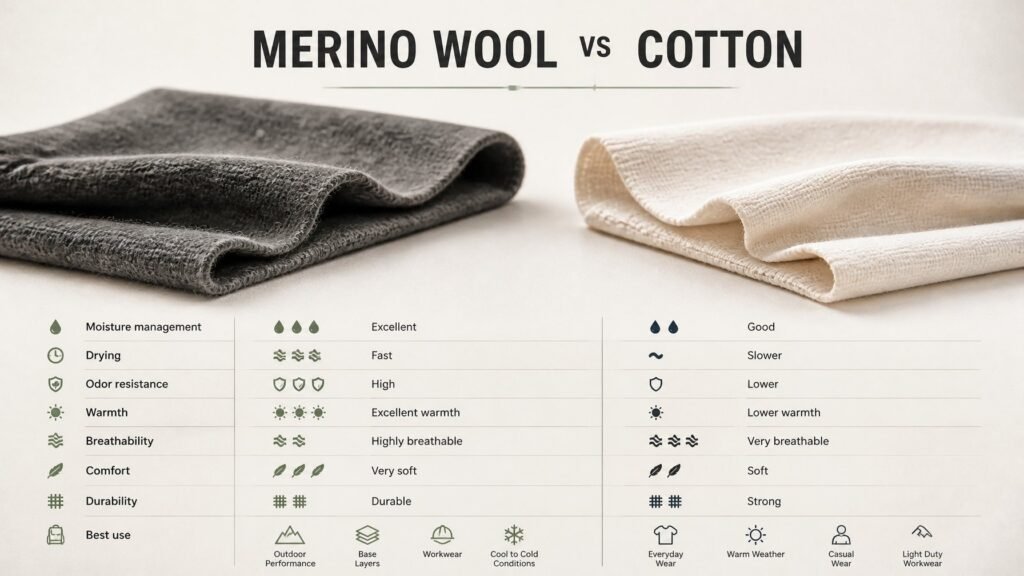
| Factor | Merino Wool | Cotton |
| Fiber type | Natural animal fiber | Natural plant fiber |
| Moisture behavior | Strong moisture-vapor management; fabric design affects liquid transport | Naturally absorbent; wicking performance depends strongly on fabric construction and treatment |
| Drying | Often performs better than conventional cotton during active use, but construction matters | Conventional cotton may remain wet longer; engineered cotton can dry much faster |
| Odor | Strong natural odor-management advantage | Usually needs more frequent laundering after sweaty use |
| Breathability | Generally good; depends on weight, knit and garment design | Generally good; also depends on weight, weave/knit and garment design |
| Temperature regulation | Strong across changing conditions | Comfortable in many warm, dry, low-to-moderate activity settings |
| Warmth | Efficient insulation in appropriate constructions | Warmth varies widely with fabric weight and construction |
| Durability | Good with suitable construction, but fine merino can pill or suffer abrasion | Can be highly durable; construction and finishing matter |
| Comfort | Fine merino is softer than coarse traditional wool | Soft, familiar hand feel |
| Care | Often needs a wool/delicate cycle and careful drying | Garment-specific, but everyday cotton products are often straightforward to launder |
| Cost | Usually positioned as a premium apparel fiber | Broad price range, often more affordable |
| Best uses | Base layers, travel, hiking, repeated wear, variable conditions | Everyday clothing, casual warm-weather wear, lower-cost basics |
The table is deliberately qualified because fiber type alone does not determine performance. Fabric thickness, density, porosity, knit or weave, finishing and garment design can substantially change thermal and moisture behavior. Textile research identifies factors such as fabric weight, thickness, density, air permeability and moisture regain as important contributors to comfort.
What Is Merino Wool?
Merino wool is wool produced by Merino sheep and used in apparel ranging from socks and sweaters to base layers and technical clothing. Compared with coarse traditional wool, fine Merino fibers bend more easily against the skin, which is why well-made merino garments can feel considerably softer than the heavy wool clothing many people associate with the word “wool.”
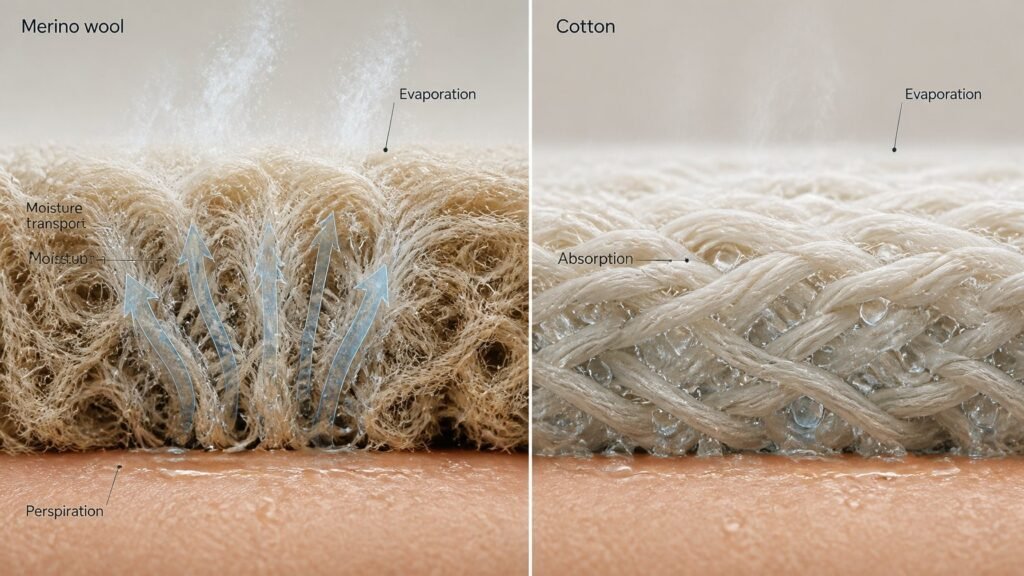
One of merino’s most useful characteristics is how it interacts with moisture vapor. Wool can absorb moisture vapor within its fiber structure and later release it as surrounding conditions change. Woolmark describes this behavior as helping regulate the small microclimate between skin and clothing.
That does not mean merino instantly removes every form of sweat. Woolmark specifically distinguishes moisture vapor from liquid water: Merino handles vapor effectively, while liquid moisture is more difficult for the fiber itself to manage. Fabric construction therefore still matters when judging a particular merino running shirt or base layer.
Merino is also well known for odor management. Wool can retain odor molecules within its fiber structure, which helps wool garments remain fresher between washes compared with many alternatives. Peer-reviewed research also supports wool’s comparatively favorable odor behavior in apparel.
These properties make merino popular for base layers, travel apparel, hiking clothing, socks and other garments worn across changing temperatures or for extended periods.
What Is Cotton?
Cotton is a natural plant fiber composed primarily of cellulose and is one of the world’s most familiar clothing materials. It is widely used because it can produce soft, comfortable and breathable fabrics in a huge range of weights and constructions.
Cotton is absorbent, which is important to distinguish from wicking.
Absorption describes moisture entering or being held within a material. Wicking describes liquid moving through the structure of a fabric, either across its surface or from one side to another. CottonWorks defines wicking specifically as a fabric’s ability to transport liquid through or across its structure.
That means the common claim that “cotton does not wick” is too simplistic.
Conventional cotton readily absorbs moisture and may retain significant moisture during heavy sweating. But specially engineered cotton fabrics can be designed to move moisture directionally and accelerate evaporation. Cotton Incorporated’s TransDRY technology, for example, demonstrates that cotton construction and finishing can substantially change its moisture-management and drying behavior.
For ordinary cotton clothing, however, high moisture absorption can become a disadvantage during prolonged sweating because more retained water generally means more moisture must leave the garment before it feels dry again.
Merino Wool vs Cotton: Key Differences
Moisture Wicking and Sweat
When comparing merino wool vs cotton moisture wicking, avoid reducing the answer to a single number.
Sweat management involves several processes:
- moisture leaving the skin;
- vapor or liquid entering or contacting the garment;
- liquid spreading through the fabric;
- moisture reaching a larger exposed surface;
- evaporation into the surrounding air.
Merino is particularly effective at dealing with moisture vapor. Its fiber structure can absorb and release vapor as environmental conditions change.
Cotton readily absorbs liquid moisture. Conventional cotton can therefore become saturated during prolonged sweating, but cotton can also be engineered for strong liquid transport. Cotton Incorporated documents fabrics that move moisture from the skin-facing side outward and increase the area available for evaporation.
For high-sweat situations, do not choose purely by fiber name. Look at the specific garment’s weight, construction and moisture-management design.
For a deeper comparison involving performance synthetics, see BRS’s guide to polyester vs cotton. BRS also has a separate explanation of moisture-wicking work shirts.
Drying Speed
Merino generally has a practical advantage over ordinary cotton when clothing is being worn through variable or sweaty conditions, but there is no universal drying-time ratio that applies to every merino and cotton garment.
Drying depends on how much water the garment holds, surface area, fabric thickness, airflow, humidity, temperature and construction. Engineered cotton is an especially important exception: performance treatments and constructions can reduce moisture retention and spread moisture more effectively for faster evaporation.
Why does this matter? A shirt that remains saturated can become heavier, cling more and require more time before it is comfortable for another activity. Drying therefore matters for hiking, travel, running, prolonged outdoor work and any activity in which the same garment remains on the body after heavy sweating.
If drying time is your main comparison, BRS’s dedicated guide Does Polyester Dry Faster Than Cotton? covers the synthetic-vs-cotton question separately.
Warmth and Temperature Regulation
For merino wool vs cotton warmth, merino usually has the stronger reputation, but fiber alone does not tell you how warm a garment will feel.
Wool fibers and wool fabric structures can trap insulating air, while Merino’s interaction with moisture helps moderate the microclimate next to the body. Woolmark describes merino as a temperature-regulating fiber used across changing conditions.
But a lightweight merino T-shirt is not automatically warmer than a heavy cotton sweatshirt. Fabric weight, thickness, trapped air, knit density, garment fit, layering, wind and activity level can outweigh the simple fiber comparison.
So the useful answer is:
Merino usually provides more versatile thermal performance for performance layers, but garment construction determines the actual warmth of the clothing you wear.
Breathability
Both merino and cotton can be breathable.
Claims such as “wool is breathable” or “cotton is breathable” are useful starting points but incomplete descriptions. Air permeability is strongly influenced by yarn and fabric structure. A lightweight open-knit fabric can pass far more air than a thick, dense fabric made from the same fiber.
Textile research has found that properties including fabric thickness, density, porosity and air permeability affect thermal and moisture comfort.
For summer clothing, therefore, compare not only merino vs cotton but also fabric weight, knit structure, fit and ventilation.
Odor Resistance
Merino has the clearer advantage here.
Wool fibers can absorb both moisture vapor and odor-related compounds, helping reduce noticeable odor accumulation between washes. Woolmark documents this property, while research reviewing sportswear odor also identifies favorable odor outcomes from wool-containing textiles.
That does not mean merino “never smells.” Sweat, bacteria, environmental contamination, garment construction and time between washes all matter.
For travelers, hikers and anyone hoping to re-wear a garment before washing it, however, odor management is one of merino’s most meaningful practical strengths.
Durability
There is no responsible way to declare either fiber universally more durable.
A heavy cotton work shirt can survive conditions that would quickly damage an ultralight merino tee. Conversely, a well-made merino garment can remain useful for years when worn and washed appropriately.
Fine wool can also pill, particularly where repeated abrasion occurs. Woolmark’s own care guidance recommends minimizing abrasion when trying to reduce pilling.
Cotton durability also changes dramatically with yarn quality, fabric weight, finishing and construction. Cotton Incorporated even develops performance treatments specifically to increase abrasion resistance, illustrating why “cotton” alone does not describe durability.
For workwear, inspect the complete garment rather than selecting by fiber label alone.
Comfort
Cotton’s familiar softness makes it a strong everyday choice, particularly when the garment remains relatively dry.
Fine merino can also feel soft against the skin because its finer fibers bend rather than behaving like the stiffer, coarser fibers associated with some traditional wool garments.
Comfort changes once sweat accumulates. Some people prefer cotton’s initial hand feel; others prefer how merino behaves during prolonged wear.
Fit, seams, fabric weight and personal skin sensitivity can be just as important as fiber type.
Care and Washing
Always follow the garment’s care label.
Many modern wool garments can be machine washed, but Woolmark recommends a wool cycle or gentle/cold cycle where appropriate, mild detergent and care when drying. Flat drying is commonly recommended for wool garments.
Cotton care also varies by construction, dye, finish and garment type. Heat can alter some cotton garments, so “cotton can always be washed and dried however you want” is not a reliable rule either.
If easy, frequent laundering is a major requirement, compare the actual care labels of the garments you are considering rather than making the decision from fiber content alone.
Cost
Merino clothing is commonly positioned as a premium product, particularly in technical outdoor and travel apparel, while cotton is available across a much broader mass-market price range. Current merino-vs-cotton apparel comparisons likewise identify price as one of cotton’s practical advantages.
Actual prices vary enormously by brand, garment construction, sourcing, fiber quality and finishing, so cost should be compared at the garment level.
Merino Wool vs Cotton for Hot Weather
For hot weather, both merino and cotton can work. The better choice depends heavily on how much you expect to sweat.
For casual summer use with modest activity, a lightweight cotton shirt can be comfortable because cotton can be soft, breathable and pleasant against the skin.
For prolonged activity, travel or conditions where the garment repeatedly becomes damp, lightweight merino gains advantages from moisture-vapor management and odor resistance.
Humidity complicates the comparison because evaporation becomes more difficult as surrounding air holds more moisture. No fiber can make evaporation unlimited in very humid conditions.
The practical distinction is therefore:
Casual summer wear: lightweight cotton can be an excellent option.
Active, sweaty summer use: lightweight merino may offer more useful moisture and odor management, although purpose-built synthetic or engineered performance fabrics should also be considered.
For job-specific advice, see BRS’s guide to the best work shirts for hot weather, which focuses on outdoor labor rather than general summer clothing.
Merino Wool vs Cotton Base Layer: Which Is Better?
Merino wool is generally the better choice for a performance base layer when substantial sweating, temperature changes or repeated wear are expected.
A base layer sits next to the skin, so moisture behavior is especially important. Merino’s moisture-vapor management, thermal properties and odor control make it useful for hiking, cold-weather layering, travel and variable activity levels.
Conventional cotton can absorb a substantial amount of sweat and remain damp longer, making it less attractive as a technical base layer when the wearer expects prolonged exertion.
That does not make cotton a “bad” fabric. A cotton undershirt can work perfectly well in low-intensity, controlled environments. The problem appears when a casual garment is expected to perform like technical apparel.
If you are choosing merino wool or cotton for a base layer, consider activity intensity, expected sweat, temperature changes, drying opportunities, garment weight and how long you intend to wear the layer.
Merino Wool vs Cotton for Running
For running, merino usually makes more sense than conventional cotton when moisture management and odor matter.
On short, easy runs in mild weather, many runners may be perfectly comfortable in cotton. But as distance, sweat or weather variability increases, retained moisture becomes more noticeable.
A lightweight merino running shirt offers moisture-vapor management and odor resistance, making it particularly attractive for longer sessions, cooler conditions and situations where the shirt will be worn for an extended period.
Still, merino vs cotton is not the only running comparison. Purpose-built synthetic running fabrics can be designed specifically for liquid sweat transport and fast drying. Fabric weight, fit and construction deserve as much attention as the fiber name.
Merino Wool vs Cotton for Work Shirts

A fabric that works well for hiking or running is not automatically the best choice for a professional work uniform.
Work shirts face a different combination of demands:
- prolonged outdoor heat;
- sweat and repeated wetting;
- frequent laundering;
- abrasion and physical movement;
- dirt, grease or other contamination;
- consistent team appearance;
- branding requirements;
- replacement cost;
- and, in certain trades, chemical or bleach exposure.
Merino’s odor management and temperature-regulating characteristics can certainly be valuable in some workwear applications. Woolmark itself documents merino use in professional and technical workwear.
Cotton remains practical where familiar comfort, cost and everyday wear are higher priorities.
But a professional uniform should be chosen as a complete system: fiber, fabric construction, garment design, finishing, printing method, wash requirements and workplace exposure.
For outdoor crews specifically dealing with heat, BRS’s hot-weather work shirt guide goes deeper into lightweight construction, moisture management and job-specific requirements.
What Fabric Is Best for Pressure Washing Shirts?
Pressure washing changes the fabric decision because workers may deal not only with heat and sweat but also with water, repeated laundering and bleach-based cleaning solutions.
That means the relevant question is not simply “merino wool or cotton?”
A pressure-washing shirt needs to be evaluated for the exact chemical and physical conditions in which it will be used.
BRS currently describes its pressure washing shirts as moisture-wicking, lightweight and made with premium polyester, and states that its pressure-washing fabric is designed to resist bleach exposure.
Importantly, BRS’s homepage uses the wording “Bleach Resistant – Not Proof.” That distinction matters. No blanket claim should be made that all polyester is bleach-resistant or that a BRS garment is impervious to bleach.
For chemical-heavy professional work, select clothing on the basis of the finished garment’s documented performance and intended application rather than assuming that the underlying fiber automatically provides chemical resistance.
The same principle applies to crews working in landscaping. BRS offers dedicated custom landscaping shirts positioned for outdoor work, moisture management and customized branding.
Need custom work shirts for a demanding outdoor job?
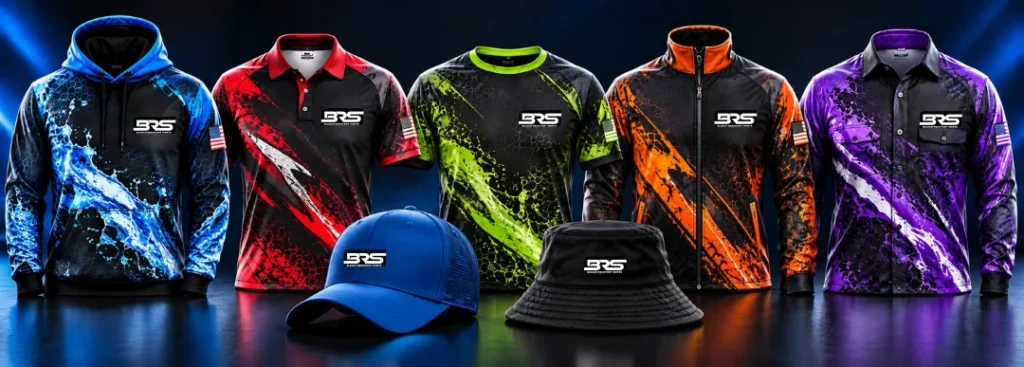
BRS creates customized uniforms for pressure washing, landscaping, lawn care and other service businesses. You can submit your requirements through Design Now to receive a digital mockup before production.
Merino Wool vs Cotton: Which Should You Choose?
Choose merino wool when your priorities are odor management, variable temperatures, performance layering, repeated wear and natural-fiber technical apparel.
Choose cotton when your priorities are familiar softness, broad availability, everyday casual wear and access to a wide range of price points.
For high-sweat activity, look beyond the label and evaluate fabric construction and drying behavior.
For professional outdoor work, consider durability, washing frequency and uniform requirements alongside comfort.
For pressure washing or other work involving bleach exposure, neither a generic “merino” nor “cotton” label is enough. Look for a finished garment specifically designed and documented for the job.
That is the central lesson of the merino wool vs cotton comparison: the right fiber depends on the conditions in which you actually expect the garment to perform.
Frequently Asked Questions
Is merino wool better than cotton?
Merino wool is generally better for temperature regulation, odor management and performance layering, while cotton is a strong choice for comfortable, affordable everyday clothing. The better option depends on activity, weather and garment construction.
Is cotton cooler than merino wool?
Not automatically. A lightweight cotton shirt can feel comfortable in warm weather, while lightweight merino can manage moisture vapor effectively during changing conditions. Fabric weight, airflow, humidity and activity level also influence how cool either garment feels.
Is merino wool good for summer?
Yes. Lightweight merino can work well in summer because it manages moisture vapor and offers natural odor resistance. Heavy merino garments, however, are designed for different conditions, so fabric weight matters.
Is merino wool better than cotton for sweating?
For prolonged sweating, merino generally has advantages over conventional cotton because of its moisture-vapor management and odor resistance. However, engineered cotton can also provide advanced liquid-wicking performance, so garment construction matters.
Which is warmer, merino wool or cotton?
Merino generally provides stronger insulation for performance layering, but a garment’s weight, thickness, knit and fit strongly affect warmth. A heavy cotton garment can easily be warmer than a very lightweight merino shirt.
Does merino wool dry faster than cotton?
Merino often performs better than conventional cotton in wet or sweaty apparel use, but drying speed depends on fabric construction, water retention, thickness, airflow and humidity. Performance-engineered cotton can also be designed for much faster drying.
Is merino wool good for a base layer?
Yes. Merino is widely used for base layers because it manages moisture vapor, helps regulate the next-to-skin microclimate and offers natural odor management.
Is cotton good for a base layer?
Cotton can be comfortable for low-intensity everyday use, but conventional cotton is usually less suitable for high-sweat performance layering because it can absorb and retain substantial moisture.
Is merino wool good for running?
Yes, especially when odor management, changing temperatures and prolonged wear matter. For very high-output running, compare lightweight merino with purpose-built synthetic performance fabrics as well.
Is cotton good for running?
Cotton can be acceptable for short, low-intensity runs, particularly in mild conditions. For prolonged or very sweaty runs, moisture retention can make conventional cotton less comfortable.
Which is better for work shirts, merino wool or cotton?
Neither is universally better. Merino can be useful where odor and temperature management are priorities; cotton can be practical for comfortable everyday workwear. For demanding outdoor jobs, evaluate durability, washing, sweat management and job-specific exposures too.
What is the best fabric for hot-weather work?
The best fabric depends on activity, humidity and the job itself. Lightweight, breathable construction and effective moisture management matter more than simply choosing a fiber by name. For sustained sweaty work, quick-drying performance fabrics are often more practical than conventional absorbent cotton.
What is the best fabric for pressure washing shirts?
Pressure-washing workwear should be selected for moisture management, repeated washing, durability and the specific chemical exposure involved. BRS uses performance polyester in its pressure-washing shirts and describes those garments as bleach-resistant, not bleach-proof.