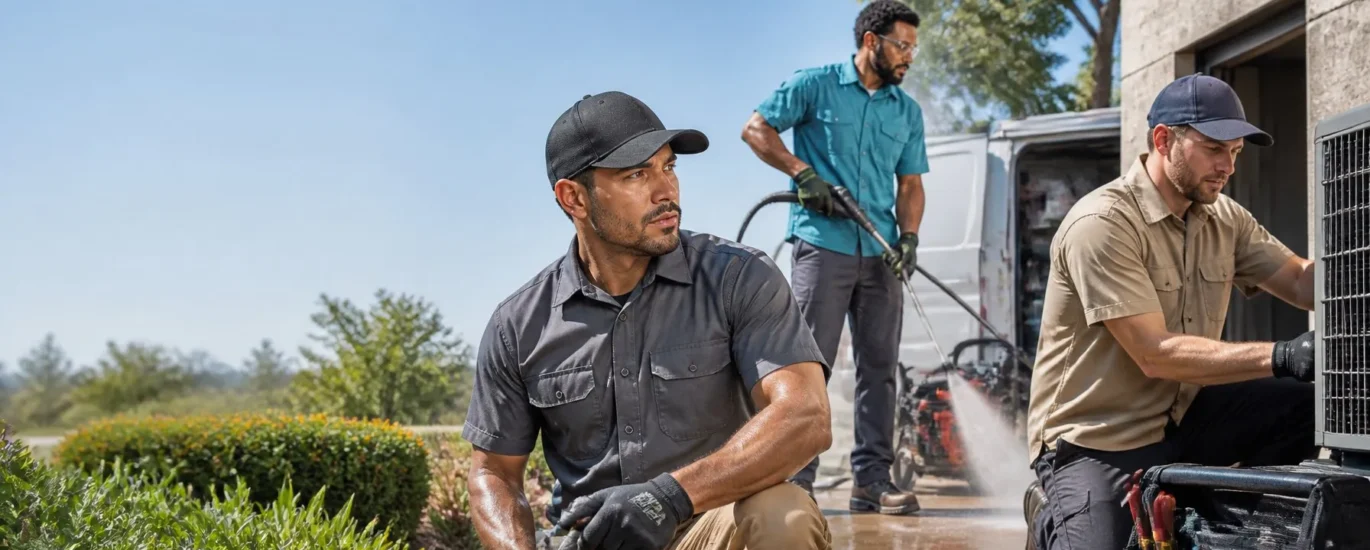
Working outside on a hot day is different from spending an hour at the gym. Pressure washing crews, landscapers, HVAC technicians, cleaners, pest control professionals, automotive detailers, and other service workers may spend hours moving between heat, humidity, direct sunlight, customer properties, vehicles, equipment, and physically demanding tasks.
That makes the shirt you wear more than a matter of appearance.
Sweat resistant shirts are garments designed to help manage perspiration, reduce the uncomfortable feeling of wet fabric, or make sweat less noticeable, depending on the garment’s construction. The term does not mean a shirt prevents your body from sweating.
For workwear, the better question is not simply, “Is this shirt sweat resistant?” It is: How does the shirt handle moisture, how breathable is it, how quickly does it dry, and is it suitable for the conditions in which your crew actually works?
Understanding those differences can help you choose more practical work shirts for hot, active environments.
What Are Sweat Resistant Shirts?
“Sweat resistant” is a broad consumer term rather than one single technical fabric specification.
Depending on the product, a sweat resistant shirt may be designed to move perspiration away from the skin, dry relatively quickly, improve airflow, reduce the appearance of sweat marks, or combine several of these characteristics.
That is why two shirts marketed as sweat resistant can perform differently.
A useful way to think about sweat management is:
Sweat reaches the fabric → moisture moves or spreads through the material → more of the moisture is exposed to air → evaporation and drying can occur.
Research into textile moisture transfer shows that wicking and evaporation are closely connected and that fabric structure, porosity, fibers, and finishing can affect how water moves through a textile.
For a worker, the practical goal is generally not to eliminate sweating. It is to choose clothing that is appropriate for the work environment and does not unnecessarily interfere with comfort or moisture management.
How Do Sweat Resistant Shirts Work?
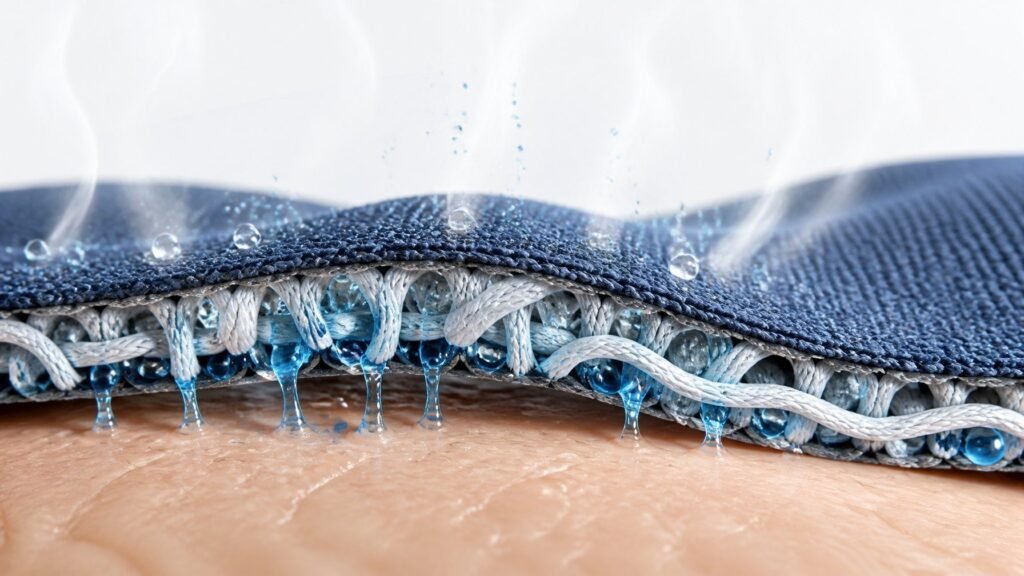
Many shirts described as sweat resistant rely on moisture-wicking properties.
Wicking is the movement of liquid through small spaces within a fabric. Capillary action can help move moisture through and across the textile, spreading it over a larger area. Once moisture reaches areas exposed to the surrounding air, evaporation can take place.
In simple terms:
1. You perspire.
Sweat reaches your skin and clothing.
2. The fabric manages the moisture.
A moisture-wicking construction can help transport or spread liquid rather than allowing it to remain concentrated in one location.
3. Moisture reaches a larger surface area.
Spreading can increase the area from which water can evaporate. Research on porous fabrics confirms that spreading and wicking affect the wetted surface area and evaporation behavior.
4. Moisture evaporates.
Environmental conditions such as temperature, humidity, airflow, and the properties of the garment all influence drying.
This process does not make a shirt magically dry under every condition. High humidity, heavy perspiration, fabric saturation, protective equipment, and the intensity of the work can all affect how a garment feels and dries.
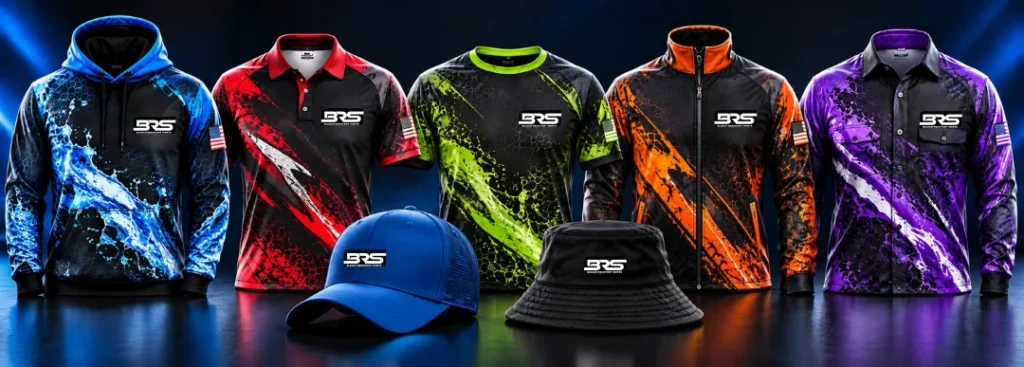
For businesses specifically looking for this type of apparel, BRS already offers moisture-wicking work shirts as part of its workwear range. The site also distinguishes moisture-wicking workwear as its own category, which is useful because “moisture-wicking” is more specific than the general term “sweat resistant.”
Sweat Resistant vs. Moisture-Wicking vs. Breathable Shirts
These terms are often used together, but they do not mean exactly the same thing.
| Term | What It Means |
| Sweat resistant | A broad description for clothing intended to manage sweat, reduce wetness or, in some products, reduce visible sweat marks. |
| Moisture-wicking | Fabric or construction designed to transport and spread liquid moisture away from the skin-facing area. |
| Breathable | Clothing that allows heat and moisture exchange to varying degrees rather than creating an unnecessarily closed environment. |
| Quick-drying | A garment designed or constructed to release retained moisture relatively quickly under suitable conditions. |
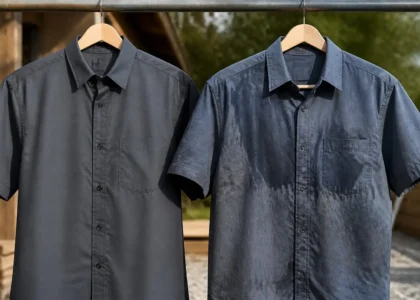
| Sweat-stain resistant | Usually refers to reducing the visibility or persistence of sweat marks rather than preventing perspiration. |
| Sweat-proof | Primarily a marketing description. What it means depends on the individual product and should be checked carefully. |
| Stain resistant | Designed to resist certain stains. This does not automatically mean sweat, chemical, or bleach resistance. |
| Bleach resistant | Refers specifically to resistance to discoloration or damage associated with bleach exposure under the conditions for which a garment is designed. It does not mean sweat resistant or bleach proof. |
The distinction matters when buying uniforms.
Someone purchasing sweat resistant work shirts for a landscaping crew may care most about breathability and moisture management. A pressure washing company may also need to consider how uniforms perform around the substances encountered during the job.
One label cannot answer every workwear requirement.
Do Sweat Resistant Shirts Stop You From Sweating?
No. Sweat resistant shirts do not stop the human body from producing perspiration.
Sweating is one of the body’s mechanisms for releasing heat. NIOSH notes that heat stress is influenced by environmental heat, physical exertion, clothing, and personal protective equipment, among other factors.
A work shirt should therefore not be treated as a replacement for a proper workplace heat-safety program.
Appropriate uniforms can help with comfort and moisture management, but employers still need to consider hydration, rest, shade or cooling areas, acclimatization, workload, environmental conditions, and required PPE. NIOSH specifically recommends appropriate hydration and rest periods as part of workplace heat-stress prevention.
What Fabric Is Best for Sweat Resistant Work Shirts?
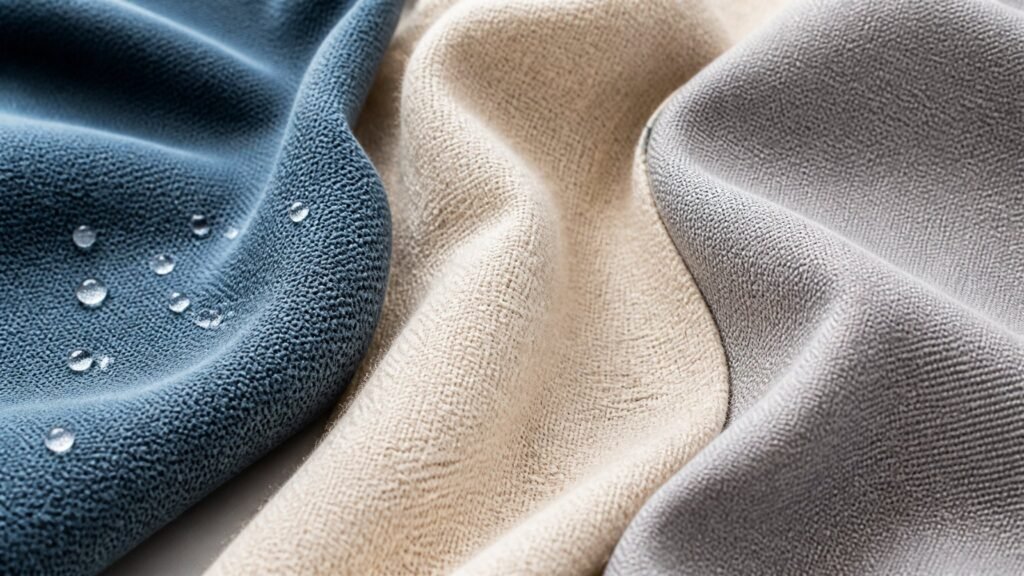
There is no single fabric that is automatically “best” for every worker.
Performance depends on the fiber, weave or knit, garment construction, fabric weight, finishes, fit, environmental conditions, and the type of work being performed. Textile research shows that moisture transport is affected by both material characteristics and fabric structure.
Polyester and Performance Synthetics
Polyester is commonly used in performance workwear because it can be engineered into lightweight, moisture-managing, quick-drying fabrics.
For example, trade-focused workwear manufacturers use polyester in moisture-wicking performance shirts intended for physically active workers.
However, the word polyester alone does not guarantee performance. Fabric construction and finishing still matter.
Cotton
Cotton absorbs moisture readily, which can feel comfortable in some conditions but can also mean the garment retains more moisture when heavily saturated.
At the same time, cotton should not simply be dismissed as “bad for heat.” NIOSH guidance for workers exposed to heat has historically recommended light-colored, loose-fitting, breathable clothing and includes cotton as an example.
This is why blanket statements such as “polyester is always better than cotton” are misleading.
Cotton-Polyester Blends
Blends attempt to combine properties of different fibers. Their real-world performance depends on the blend ratio, garment construction, weight, and any additional treatments.
Do not choose a work shirt based only on a fiber percentage. Consider the entire garment.
Performance Fabrics
“Performance fabric” is another broad term.
Some performance textiles use fiber geometry, construction, surface treatments, or combinations of hydrophobic and hydrophilic behavior to influence how moisture travels through the material.
When purchasing crew uniforms, look for clearly described garment properties rather than relying on the word “performance” by itself.
What Makes a Good Work Shirt for Hot Weather?
A hot-weather work shirt has to solve more problems than an ordinary casual T-shirt.
Consider these factors before ordering uniforms:
- Breathability: Does the garment allow appropriate air and moisture exchange?
- Moisture management: Is the fabric designed to move or spread perspiration?
- Drying characteristics: How is the garment intended to behave after becoming wet?
- Fit: A work shirt should allow appropriate movement without interfering with the job.
- Fabric weight: Heavy and light garments can feel very different during prolonged outdoor work.
- Sleeve length: Short and long sleeves serve different requirements depending on sun exposure and the work environment.
- Job hazards: Uniform choice must account for chemicals, equipment, visibility requirements, PPE, and other workplace risks.
- Branding: The shirt also represents the company when employees are on a customer’s property.
- Care: Crew uniforms should have realistic washing and maintenance requirements.
- Sizing: Consistent sizing becomes especially important when ordering for multiple employees.
NIOSH notes that clothing can influence heat exchange and that thicker or less permeable clothing can impede heat loss and sweat evaporation.
BRS also has dedicated lightweight work shirts and summer work shirts pages for businesses comparing workwear around these needs. Both are existing parts of the site’s workwear architecture.
Are Sweat Resistant Shirts Good for Outdoor Work?
They can be, provided the shirt’s actual properties match the job and working conditions.
Outdoor workers often combine physical exertion with heat, humidity, direct sunlight, equipment, and job-specific hazards. NIOSH identifies physical exertion, direct sun exposure, temperature, humidity, clothing, and PPE among the factors affecting occupational heat stress.
The right uniform therefore depends partly on the industry.
Pressure Washing and Soft Washing
Pressure washing crews may work outdoors for long periods while moving hoses, operating equipment, walking around properties, and working in changing weather.
Moisture management is valuable, but it is only one consideration. The uniform also needs to fit the company’s chemical and job-site requirements.
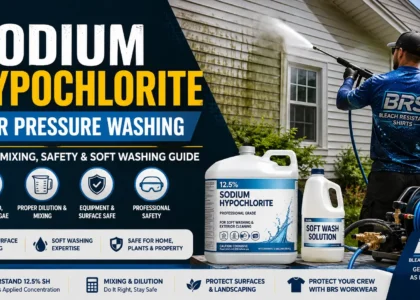
This distinction is especially important for pressure washing because sweat resistance does not mean bleach resistance.
Businesses choosing uniforms for this environment can compare BRS’s dedicated pressure washing shirts rather than assuming an ordinary sweat-wicking athletic shirt is designed for the same job. Pressure Washing Shirts is a core category in BRS’s current uniform architecture.
Landscaping and Lawn Care
Landscaping crews can spend much of the day walking, lifting, mowing, trimming, carrying equipment, and working in direct sun.
A useful uniform needs to balance movement, moisture management, durability, professional presentation, and whatever safety requirements apply to the job.
Businesses outfitting these crews can explore dedicated landscaping work shirts and lawn care work shirts instead of selecting uniforms solely because they are marketed as sweat proof. Both industry categories are part of BRS’s current site structure.
Cleaning Companies
Cleaning employees often move continuously between rooms, buildings, indoor and outdoor spaces, and different temperature conditions.
For these crews, moisture management should be considered alongside ease of movement, uniform consistency, appearance, and exposure to cleaning products.
BRS maintains a dedicated cleaning work shirts category for this use case.
HVAC and Pest Control
HVAC technicians may move between air-conditioned spaces, rooftops, attics, crawlspaces, and outdoor equipment. Pest control professionals similarly move between customer-facing environments and physically active fieldwork.
Those changes make versatility important.
A shirt that feels appropriate in a customer’s home should also remain practical when the technician moves into a hotter work area. Employers should still follow applicable PPE and safety requirements because an ordinary moisture-wicking shirt is not a substitute for protective equipment.
BRS has separate HVAC shirts and pest control shirts pages within its workwear offering.
Automotive and Detailing
Automotive technicians and detailing crews can work around hot vehicles, garages, outdoor lots, water, dirt, cleaning products, and constant movement.
Here, sweat management is only one part of the decision. The uniform also needs to support a professional, recognizable appearance when employees interact with customers.
BRS’s automotive work shirts category provides a more job-specific route for automotive businesses selecting uniforms.
What Should Pressure Washing Crews Look for in a Work Shirt?
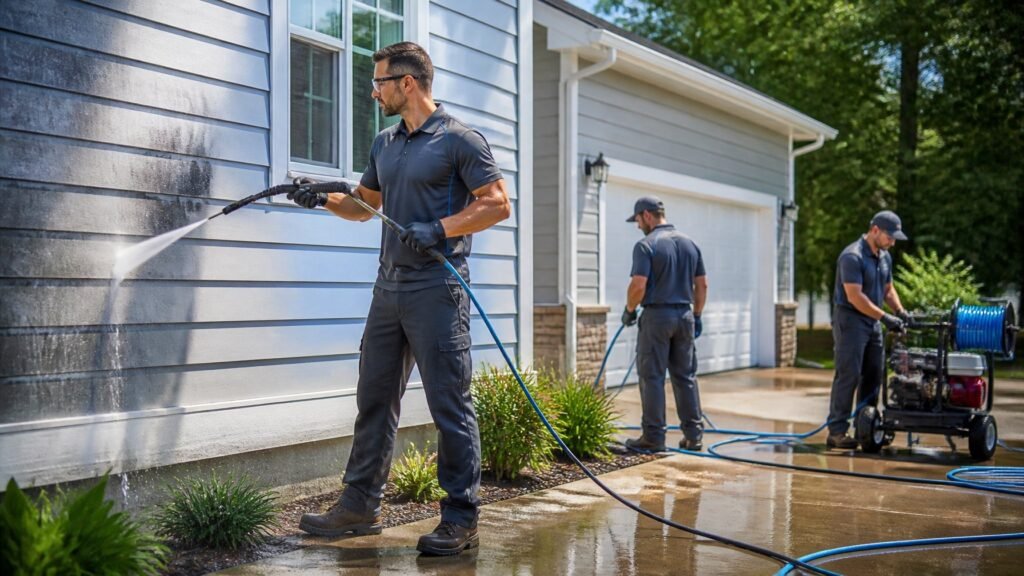
For pressure washing businesses in particular, start with the actual working environment rather than a generic “sweat-proof” label.
A practical evaluation should include:
- Heat and humidity: How much of the shift is spent outdoors?
- Physical workload: How much movement and exertion does the job involve?
- Moisture management: How does the shirt handle perspiration and other moisture?
- Breathability: Is the garment appropriate for extended active use?
- Fit and movement: Can employees work comfortably while handling equipment?
- Chemical environment: Is the garment actually designed for substances workers may encounter?
- Visibility: Are high-visibility requirements relevant to the job?
- Branding: Can customers easily identify the company and crew?
- Sizing: Can the business outfit different employees consistently?
- Care: Is the uniform practical for repeated work use?
Remember that a work shirt is only one part of managing heat. Required PPE, hydration, rest periods, acclimatization, and workplace controls remain separate safety considerations.
Sweat Resistant Shirts vs. Bleach Resistant Shirts
Sweat resistance and bleach resistance address different problems.
A sweat-resistant or moisture-wicking shirt primarily concerns how a garment manages perspiration or wetness.
A bleach-resistant shirt concerns the garment’s ability to resist certain effects associated with bleach exposure under its intended conditions.
A shirt can therefore have useful moisture-management properties without being designed for bleach exposure. Likewise, bleach resistant should not be interpreted as bleach proof.
This distinction matters for pressure washing, cleaning, pool service, and other businesses where workers may encounter chemicals.
BRS positions its workwear around custom sublimated uniforms and lists both bleach resistance and moisture-wicking apparel within its offering, while maintaining dedicated pages for different workwear requirements.
For businesses that need both professional branding and job-specific workwear, the selection should be based on the complete garment specification rather than assuming that one performance feature automatically provides another.
How to Choose the Right Sweat Resistant Work Shirt
Before placing a crew order, use this practical checklist:
- Identify the temperatures and environments in which employees normally work.
- Determine how physically demanding the work is.
- Check whether the garment provides clearly described moisture-management properties.
- Consider breathability and fabric construction, not just fiber type.
- Compare short- and long-sleeve requirements.
- Check fit and freedom of movement.
- Identify any PPE, chemical, visibility, or safety requirements separately.
- Consider how the company logo and branding will appear during real work.
- Review washing and care requirements.
- Confirm sizes before ordering for an entire crew.
- Avoid treating “sweat proof,” “performance,” or “cooling” as guarantees without checking what the manufacturer actually means.
For custom crew uniforms, BRS provides a free mockup process before an order is finalized. Businesses can get a free custom mockup to see how their branding can work on a shirt design. The free-mockup option is explicitly offered on the current BRS website.
Frequently Asked Questions About Sweat Resistant Shirts
What is a sweat resistant shirt?
A sweat resistant shirt is generally a shirt designed to manage perspiration, reduce the feeling of wetness, dry efficiently, reduce visible sweat marks, or combine several of these functions.
Because “sweat resistant” is a broad term, check the garment’s actual moisture-wicking, breathability, drying, and fabric specifications before buying.
Do sweat resistant shirts really work?
They can help manage sweat when their fabric and construction are designed for moisture management, but results depend on the garment, environment, perspiration level, humidity, airflow, and activity.
They should not be expected to prevent sweating.
Are moisture-wicking and sweat resistant shirts the same?
Not necessarily.
Moisture-wicking describes a more specific textile function involving the movement or spreading of moisture. Sweat resistant is a broader marketing or consumer description that may refer to wicking, quick drying, sweat-stain concealment, or a combination of features.
What fabric is best for sweaty outdoor work?
There is no universally best fiber for every outdoor job. Look at breathability, garment construction, moisture management, fit, weight, drying behavior, job hazards, and environmental conditions together.
NIOSH recommends light-colored, loose-fitting, breathable clothing as part of general guidance for workers exposed to heat.
Is polyester good for sweaty work?
Polyester is widely used in moisture-wicking and performance apparel and can be constructed to transport moisture and dry efficiently. However, not every polyester shirt has the same properties.
Fiber type alone should not determine the purchase.
Are sweat resistant shirts good for pressure washing?
They can help address perspiration and comfort, but pressure washing uniforms may have additional requirements related to chemicals, visibility, branding, outdoor conditions, and the specific work being performed.
A moisture-wicking athletic shirt should not automatically be assumed to be bleach or chemical resistant.
Can sweat resistant work shirts be customized?
Yes, many performance work shirts can be branded, depending on the garment and decoration method.
For business uniforms, consider how the customization method interacts with the garment’s intended use. BRS offers custom work uniforms and a free digital mockup process for businesses considering branded designs.
Do sweat resistant shirts prevent heat stress?
No. A shirt should not be treated as a heat-stress control by itself.
NIOSH states that occupational heat stress involves environmental heat, metabolic heat from work, clothing, and PPE. Employers should use appropriate workplace controls, hydration, rest, acclimatization, and other preventive measures when heat is a hazard.
Final Takeaway
The best way to understand sweat resistant shirts is not as clothing that stops sweating, but as garments designed to manage some of the problems created by perspiration.
Moisture-wicking fabrics can transport and spread liquid. Breathability concerns heat and moisture exchange. Quick-drying describes drying behavior. Sweat-stain resistance concerns appearance. Bleach resistance addresses a different type of workwear requirement entirely.
For outdoor and physically demanding jobs, those distinctions matter.
A pressure washer, landscaper, HVAC technician, cleaner, pest control worker, or automotive detailer should choose a shirt based on the whole working environment, including moisture management, breathability, fit, movement, branding, job hazards, required PPE, and care.
If your business needs custom work shirts designed around your crew and company branding, get a free BRS custom mockup before deciding on your final uniform design.