In the world of retail psychology, there is a concept known as the “Halo Effect.”
It describes how a customer’s perception of one positive trait (like a sharp, high-quality uniform) unconsciously influences their opinion of other unrelated traits (like the quality of your products or the honesty of your advice).
We often think of uniforms just as a way to identify “who works here.” But that is the bare minimum. In a crowded retail environment, your employee’s shirt is doing heavy psychological lifting. It is either elevating your product’s value or subtly dragging it down.
If you are selling premium electronics, high-end hardware, or boutique goods, but your staff is wearing faded, ill-fitting cotton tees, you are creating a “Value Disconnect.”
Here is why upgrading your retail apparel is one of the fastest ways to boost brand authority and recall.
The Credibility Gap
Imagine walking into a high-end tech store. You have a question about a $2,000 laptop. You look around and see two employees.
- Employee A is wearing a wrinkled, generic polo shirt with a peeling logo.
- Employee B is wearing a sleek, branded performance shirt that fits well and looks crisp.
Without speaking to either of them, your brain instantly makes a judgment: Employee B knows more.
This is unfair, but it is human nature. We equate “clean and sharp” with “competent and organized.” By outfitting your team in high-quality, wrinkle-resistant apparel, you are essentially hanging a credential around their neck that says, “You can trust my advice.”
Reducing the “Friction of Asking”
The biggest killer of retail sales is the “Unknown Customer.” This is the person who has a question, can’t figure out who to ask, feels awkward interrupting a stranger, and decides to just leave and buy it on Amazon.
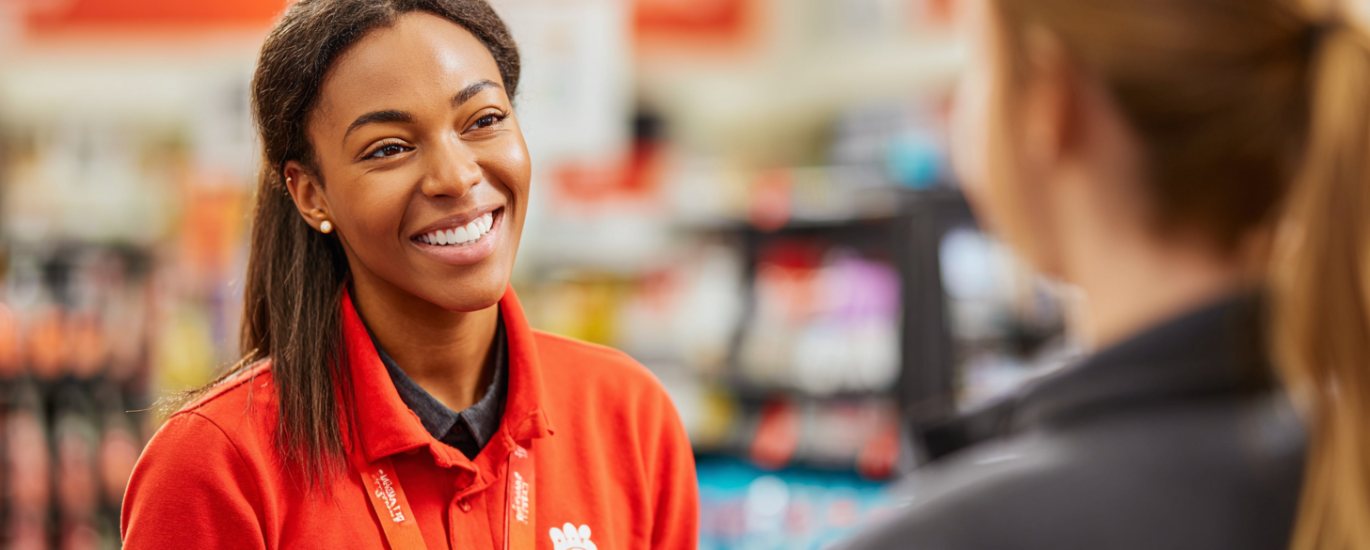
A cohesive, highly visible uniform removes this social friction. It signals Availability.
When your uniform is distinct and professional, it acts as an open invitation. It tells the customer, “I am here specifically to help you.” By making your staff “Walking Billboards” for service, you lower the barrier to entry for the conversation that leads to the sale.
The “Take-Home” Memory
Brand recall isn’t about what happens in the store; it’s about what the customer remembers after they leave.
Customers rarely remember the shelves or the lighting. They remember the interactions they had with people. If that interaction was with someone who looked polished and professional, that positive image gets attached to your brand name in their memory.
If the interaction was with someone who looked disheveled, the memory of your brand becomes “messy” or “low-tier.”
Dress Your Brand for Success
Your employees are the most active visual element in your store. They move, they talk, and they represent you. Don’t wrap your most valuable assets in cheap cotton.
Give them a uniform that closes the sale before they even say hello.
Design your Retail Store Uniform shirt today.